


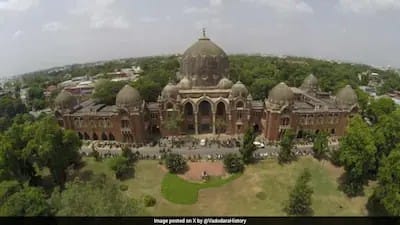
A senior Professor from The Maharaja Sayajirao University of Baroda has sparked a controversy in the campus by writing an open letter to Vice Chancellor Prof BH Bhanage to put in place a formal policy for religious rituals and practices inside the campus of MS University.
Head of the Electrical Engineering Department Jagrut Gadit expressed a concern about religious activities on an educational institution for which the taxes are being paid by the taxpayers. His letter resulted from his boycott of a C-HT-Rope-laid garland by the penchant to light a lamp before a garlanded image of Maa Saraswati in an undergraduate orientation programme.
Gadit noted that the principles of “the separation of religion and state” are part of the constitution that governs the public education system. Underlining the basic structure of the Constitution in the Kesavananda Bharati judgment of the Supreme Court in 1973, he said that “secularism” was part of the essential structure of the Constitution and that state-funded institutions should have a “non-religious atmosphere.
The professor also emphasized that he is concerned of the slow change of campus events. He said that the activities which earlier featured with just simple ribbon cutting ceremonies have now progressed and taken on religious ceremonies, often led by priests reciting Sanskrit shlokas.
Gadit said that he also refused the sheera prasad distributed by his department after doing a Satyanarayan katha on campus, and also had refused to make any donations for celebrating Ganesh Utsav at university hostels.
He had asked that aartis, pujas, Satyanarayan kathas, ceremonies for lighting the lamp with religious shlokas and adding camphor should be banned during these inaugurations, and the role of priests in these ceremonies should be avoided. He also wanted to put an end to student organised religious festivals on college campus and to university collection for these festivals.
In addition to officially organized rituals, Gadit prodded for religious symbols in classrooms, laboratories and offices. He stated that universities must foster rational research, critical thinking and open debate on rational topics, even controversial ones like atheism, and that the paths of individual religious observances should not intrude on common academic areas.
The letter has triggered further discussion of secularism, the freedom of individuals in matters of religion and the place of religion in public educational institutions.