


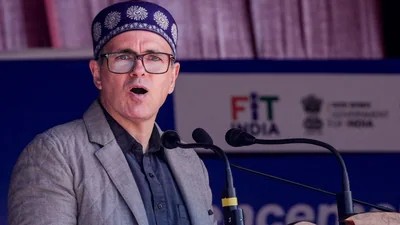
Jammu and Kashmir Chief Minister Omar Abdullah has sought to deflect his ally Congress over the Vande Mataram issue and has stated that, it is now a ‘statutory requirement’ to sing all the stanzas of Vande Mataram at its function instead of just the couldn’t be avoided part.
The remarks were made a few days back when the Congress questioned the National Conference (NC) for performing the complete version of Vande Mataram at the inauguration of the International Film Festival of Jammu and Kashmir.
Omar Abdullah said that the Congress should have come out with its concerns in Parliament before the law came into effect. He noticed that code of practice, as is the norm, would mean use of the national anthem and national song at the official meetings attended by the high-ranking constitutional executives like the Governors, Lieutenant Governor and the Acting Chief Justice.
Abdullah says that in July Vande Mataram was accorded a status on par with the national anthem, Jana Gana Mana. Additionally, Parliament enacted a law which has made it a punishable offence to insult the song which again raised debates on its historical and cultural significance.
The uniformity of such a statutory requirement makes it non specific even on India and is not of Jammu Kashmir, the chief minister said. He raised doubts about the Congress’ intent to have Kashmiris face legal action for as to follow the requirement and also pointed out that the same procedure would be followed in Congress led states.
Abdullah also announced that the national anthem will be played and the national song will be played in the closing ceremony of the film festival in the presence of a Union minister.
To consider it as “making a mountain out of molehill”, Abdullah claimed that it was not on the agenda of his party and would not be adopted. But he assured that the NC will meet all legal and statutory obligations.
The Congress has two MLAs in the 90-member Assembly in the Jammu and Kashmir government supported by the NC and is offering outside support to the NC-led government of the state.