


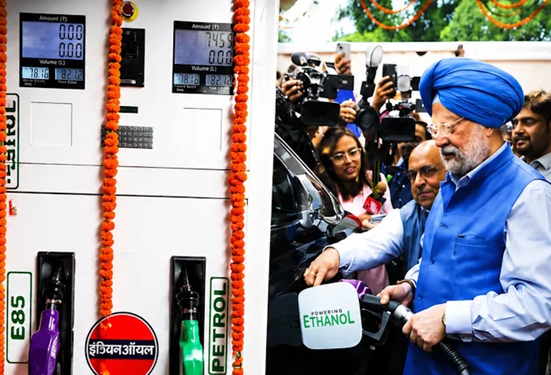
India has taken another step towards expanding ethanol-based mobility with the opening of the country’s first E85 fuel station in New Delhi. The development comes shortly after the launch of E85 fuel by the Union Ministry of Petroleum and Natural Gas on World Environment Day.
The introduction of the new fuel has triggered discussion on social media, with some users claiming that conventional petrol and diesel may eventually be phased out. However, the government has clarified that E85 is meant for a specific category of vehicles and does not affect existing petrol or E20-compatible vehicles.
E85 is a high-ethanol blended fuel containing around 80% to 85% ethanol and 14% to 19% petrol. It is part of the government’s broader effort to increase the use of domestically produced ethanol, reduce dependence on imported crude oil and strengthen India’s energy security. The fuel represents a significant increase in ethanol content compared to the E20 petrol currently available across the country.
E20 petrol contains up to 20% ethanol blended with 80% petrol and has become the standard ethanol-blended fuel being rolled out nationwide. E85, however, contains a much higher proportion of ethanol and therefore requires specially designed engines and fuel systems capable of handling high-ethanol blends. This means that while many newer vehicles are designed to operate on E20 fuel, they are not automatically compatible with E85. However, the vehicles built for conventional petrol or E20 fuel are generally not designed to run on E85. Using E85 in vehicles that are not engineered for high-ethanol blends could affect engine performance and potentially damage fuel system components over time. As a result, E85 is intended exclusively for flex-fuel vehicles.
The government has been steadily increasing ethanol blending as part of its strategy to lower crude oil imports and reduce fuel costs. Greater ethanol use can also support domestic agricultural sectors involved in ethanol production.
With E20 already established as the current benchmark fuel, policymakers are now exploring wider availability of E85 and E100 fuels for compatible flex-fuel vehicles.