


Trump announces hike in generic medicine tarrif; Read further to know how India will be affected

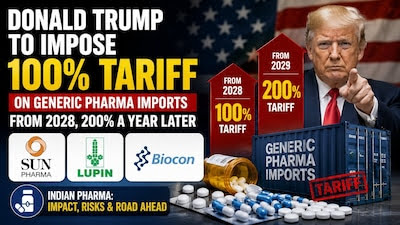
US President Donald Trump on Tuesday announced the phased tariff regime on imported generic medicines, saying they will continue to enter United States duty-free for two years, following which a steep tariff hike would be imposed. He added that the tariff hikes aimed at reshoring pharmaceutical manufacturing in the country.
“Effective August 1st, 2026, all Generic Drugs being brought into the United States will continue to have a TARIFF of ZERO PERCENT for a two year period of time, after which the TARIFF will be raised to 100% for a one year period of time, and 200% thereafter. This is done in order to reshore Generic Pharmaceutical production in America, with a penalty to those Companies that decide not to build plant and equipment within the stated period of time given to them. The objective of this Policy is to protect the people of the United States,” Trump said on taking to social media platform.
Underscoring the policy for ‘patented, branded or innovative drugs’, he reiterated that they remained unchanged. The announcement aims at a broader push to increase the domestic pharmaceutical production and lower the drug prices in the country from through his ‘most favored nation’ everyday painkillers and antibiotics to cholesterol and cancer drugs.
Major drug makers last year reached agreements with the United States government that exempted billions of dollars worth of medicines from tariffs, while Trump had also imposed tariffs on imported branded pharmaceuticals unless the manufacturers agreed to pricing deals or committed to producing them in the United States.
India is be among the key U.S. trading partners that will be hit most significantly by the new policy. India is among the top three exporters of America with a total of $10.5 billion in the previous year according to the ministry of commerce. This duty will impact 40% of India’s export to the US adversely.
According to the data, 90% of the U.S. market for Indian drug makers by volumes is via generic drugs. Out of the total generic drugs imported by the U.S, 40% of them are manufactured by India. The Indian exports are valued at around $10 billion to the United States and is also the largest number of UDFDA plants outside the country. Manufacturing a drug in India costs the US pharma sector 30 to 50% less demand against being produced in home town.
As per analysts, bringing generic manufacturing to the US is very difficult because of the constant price erosion, the high competition and the number of dosage types and strict manufacturing quality. They further added that building such large volumes could locally take decades as the US has now lost the edge in manufacturing generic medicines.
Multiple Indian companies have manufacturing presence in the US. Aurobindo Pharma has a substantial local manufacturing footprint along with Dr. Reddy’s, Lupin and Zydus Life, who also operate in the country. However, companies like Alkem Labs and Torrent Pharma are fully dependent on Indian manufacturing units and do not generate enough from the US. Companies such as Biocon also depend on India and Malaysian units for biosimilar and generic manufacturing, while Sanofi Pharma could benefit due to its local manufacturing presence for the US generic markets.
The move comes as a renewed push to use tariffs as a leverage for the United States trading partners, sparking fears of retaliation amidst heightened tension. Earlier this week, Washington announced 25% duty on certain Brazilian goods and 50% levy on Canadian products effective in 30 days.