


Pakistan Army backs government’s stand on Indus Waters Treaty, vows to secure rightful share

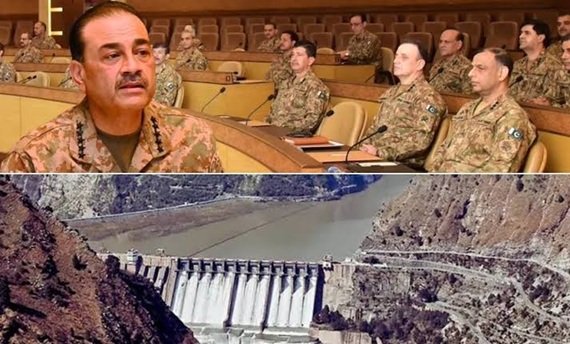
Pakistan Army on Tuesday issued a fresh warning over the Indus Waters Treaty, pledging all necessary measures to protect its water share, while India maintains the agreement will remain suspended over cross-border terrorism concerns. The move has intensified the ongoing war of words with India over the decades-old agreement.
The statement came after a meeting of Pakistan’s top military leadership chaired by Chief of Defence Staff Field Marshal Asim Munir. According to the military, the 276th Corps Commanders’ Conference reaffirmed its commitment to implementing the directives issued by Pakistan’s National Security Committee (NSC) following India’s decision to place the treaty in abeyance after the Pahalgam terror attack.
The 1960 Indus Waters Treaty, brokered by the World Bank, has governed the sharing of the Indus river system between India and Pakistan for more than six decades. India suspended the treaty after the April 2025 Pahalgam terror attack that claimed 26 lives.
In its statement, the Pakistan Army said the military leadership had expressed a “resolute commitment” to ensure Pakistan receives what it considers its rightful share of water in accordance with government directives.
The military also reiterated the NSC’s April 24, 2025 position, which declared that any attempt to stop or divert Pakistan’s water would be treated as an “act of war”.
Apart from discussing the water dispute, the commanders reviewed the country’s security situation, expressed concern over militant activities allegedly originating from Afghan Taliban-controlled territory, and reaffirmed Pakistan’s continued diplomatic, political and moral support for Kashmir.
Field Marshal Asim Munir also directed commanders to maintain a high level of operational preparedness against conventional and hybrid security threats.
The military’s remarks came days after Pakistan Peoples Party chairman Bilawal Bhutto Zardari warned that Pakistan was prepared to fight “on all fronts” over the Indus waters.
Addressing a public gathering, Bhutto accused India of attempting to “weaponise” the Indus River system and said Pakistan would not compromise on its water rights. “If we have to fight a war with India, we will fight,” he said. However, the timing of the speech could not be independently verified.
India has maintained that the Indus Waters Treaty will remain in abeyance until Pakistan takes credible and irreversible action against cross-border terrorism.
Last week, External Affairs Ministry spokesperson Randhir Jaiswal said Pakistan must “credibly and irrevocably abjure its support for cross-border terrorism.” Since the Pahalgam terror attack, India has consistently argued that bilateral agreements cannot function normally while terrorism sponsored from across the border continues.
With the treaty suspended, India is no longer required to share flood data with Pakistan under the previous mechanism. The government is also moving ahead with several hydroelectric projects in the Indus basin, including Sawalkote, Ratle, Bursar, Pakal Dul, Kwar, Kiru and Kirthai I and II.
Signed in 1960 with World Bank mediation, the Indus Waters Treaty allocates the eastern rivers—Ravi, Beas and Sutlej—to India, while Pakistan receives the waters of the western rivers—Indus, Jhelum and Chenab.
Pakistan’s agriculture is heavily dependent on the Indus river system, with nearly 80-90% of its irrigation relying on these waters. The country also has limited water storage capacity, making uninterrupted river flows critical for its farming sector.
Since India suspended the treaty, Pakistan has stepped up diplomatic efforts by approaching international forums, engaging foreign governments and raising the issue globally, while India continues to link any future implementation of the agreement to Pakistan’s action against cross-border terrorism.