


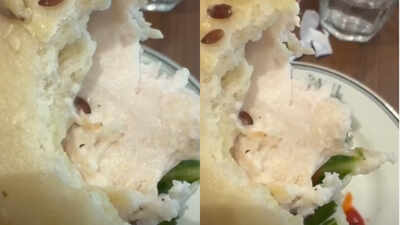
It usually takes a video for people to start asking the real questions. This week, it was the Gurugram sandwich — a diner at Paul’s, Horizon Centre, filming a live worm crawling through his meat mid-meal, then watching that clip rack up 1.3 million views and a wave of disgusted comments. But strip away the shock value for a second, and the incident is really just a symptom.
The more useful question isn’t “how did this happen at Paul’s” — it’s “why does this keep happening, period, even at restaurants people trust?” The honest answer is that it’s rarely one single failure. It’s usually several smaller ones stacking up quietly until something — or someone with a phone — finally notices.
The Math Of Scale
Restaurant chains and popular outlets are under constant pressure to serve more covers, faster, with tighter margins. When footfall spikes — weekends, festival season, a menu going viral on Instagram — kitchens that were built for a certain volume get pushed past it.
Prep shortcuts creep in. Ingredients that should be inspected batch by batch get waved through instead. None of this is deliberate negligence in most cases; it’s just what happens when a system designed for X covers a day suddenly has to handle 1.5X.
A busy 11 a.m. breakfast rush, like the one at Paul’s, is exactly the kind of window where these gaps tend to widen.
Supply Chains Nobody Checks Closely Enough
A lot of what ends up on your plate travels through two or three hands before it reaches the kitchen — wholesale vendors, cold storage facilities, delivery vans that may or may not maintain temperature control properly.
Meat, in particular, is unforgiving. It needs consistent refrigeration from the moment it’s slaughtered to the moment it’s cooked, and even a small gap in that chain — a delayed delivery, a fridge running a few degrees too warm — creates conditions where contamination, including pest infestation, becomes far more likely.
A live worm surviving long enough to be filmed on a plate points squarely at this kind of lapse somewhere upstream.
Staffing Pressure And High Turnover
The restaurant industry in India, like much of the hospitality sector globally, runs on relatively low wages and high staff churn. Kitchen staff are often overworked, undertrained on hygiene protocols, or simply new enough that they haven’t internalised the standards a restaurant claims to follow.
Training on food safety is expensive and time-consuming — and it’s one of the first things that gets compressed when a restaurant is trying to cut costs.
Regulatory Gaps — And Enforcement Gaps
There’s already a food safety framework in India, on paper. FSSAI is supposed to handle it — hygiene norms, licensing, inspections, all legally binding for any restaurant that wants to operate.
Fine system, in theory.
The problem shows up in execution. Inspectors don’t show up often enough. When violations are caught, the fines rarely sting enough to change how a kitchen actually runs day to day. And a restaurant can quietly coast for years on a reputation it built once, long before anyone bothered checking whether the kitchen still deserved it.
The Reputation Buffer
This is perhaps the least talked-about factor: an established, well-reviewed restaurant earns a kind of trust buffer.
Customers stop double-checking. Reviewers stop scrutinising as closely.
That’s likely part of why the Paul’s video hit as hard as it did — this wasn’t a roadside stall with no reputation to lose; it was a restaurant people walked into with their guard down.
Ironically, that trust is exactly what allows small lapses to go unnoticed for longer — until a video forces everyone to look again.
What actually helps?
If anything is going to shift, it’ll take pressure from more than one direction at once — inspectors showing up more often, penalties that actually cost a restaurant something instead of just being an inconvenience, and yes, incidents going public the way Paul’s did.
Nobody likes admitting it, but a viral video has become its own kind of enforcement mechanism.
A clip like that can force a restaurant to clean house within a day — something a government inspector might not manage in a full year.