


NCERT’s new Class 9 textbook drops Preamble, secular references, adds Emergency chapter, sparks political row

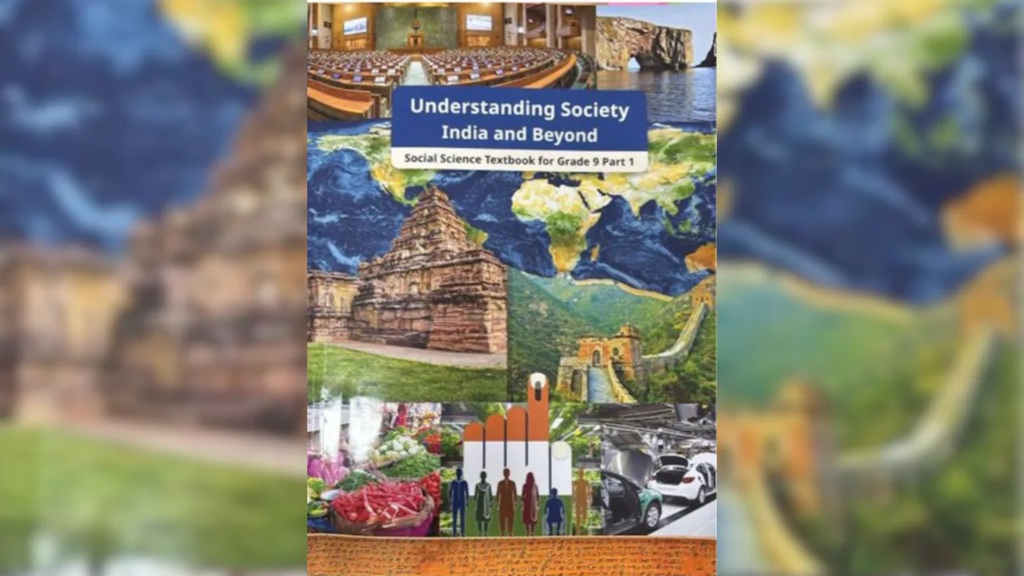
The National Council of Educational Research and Training (NCERT) on Thursday released a revised Class 9 Social Science textbook that omits the Preamble to the Constitution and references to the terms secular and secularism, while introducing a chapter on the 1975-77 Emergency for the first time at this level.
The changes, introduced under the National Education Policy (NEP) 2020 and the National Curriculum Framework for School Education (NCF-SE) 2023, have sparked a political row between the BJP and the Congress, with both parties taking sharply different positions on the revised curriculum.
The new textbook, Understanding Society: India and Beyond – Part 1, discusses the Constitution through the Constituent Assembly, constitution-making, democratic institutions and fundamental rights. Unlike the previous Class 9 Political Science textbook, Democratic Politics-I, it does not reproduce the Preamble or explain constitutional terms such as Sovereign, Socialist, Secular, Democratic and Republic. The earlier textbook had described the Preamble as the philosophical foundation of the Constitution and explained secularism as a principle under which the state has no official religion and treats all religions equally. The revised edition, however, continues to discuss constitutional values including liberty, equality, justice and fraternity, along with rights relating to equality, freedom and religion.
For the first time, the revised Class 9 curriculum includes a dedicated discussion on the Emergency imposed between 1975 and 1977. The textbook states that during the Emergency, a majority of Fundamental Rights were suspended, the press was censored and several political leaders and activists were arrested, placing democratic institutions under severe strain and restricting citizens’ freedoms. It also notes that public dissatisfaction over unemployment, inflation and allegations of misgovernance led to widespread protests, including mass movements led by Jayaprakash Narayan.
According to the textbook, the lifting of the Emergency and the 1977 general election demonstrated the resilience of Indian democracy and highlighted the importance of constitutional safeguards, civil liberties and active citizen participation.
The Emergency chapter appears under a broader section discussing challenges to democratic practices, alongside issues such as fake news, misinformation, poverty, regionalism, gender inequality and social discrimination.
Union Education Minister Dharmendra Pradhan welcomed the inclusion of the Emergency chapter, saying future generations should understand what he described as the dark deeds of the Emergency so that such events are never repeated. The BJP also defended the revision, arguing that students should learn about what it called a dark chapter in India’s democratic history.
Congress leader Sachin Pilot criticised the move, alleging that BJP attempt to reinterpret history, literature and textbooks according to their political perspective. He also argued that democracy currently faces unprecedented challenges in independent India. While Shiv Sena (UBT) leader Sanjay Raut defended former Prime Minister Indira Gandhi, saying that the Constitution itself provides for the imposition of an Emergency under certain circumstances and that doing so does not amount to disrespecting the Constitution.
The revised textbook also updates its chapter on elections, while the earlier textbook highlighted the Election Commission’s wide-ranging powers and institutional independence, the new edition focuses primarily on its constitutional responsibilities and role in conducting elections. It also includes a reference to the Special Intensive Revision (SIR) of electoral rolls, explaining that the exercise is conducted to update, verify and correct voter lists to ensure that eligible voters are included while ineligible names are removed.
The newly released 220-page integrated textbook replaces separate books on History, Geography, Political Science and Economics that were used until the 2025-26 academic session. The book will be introduced from the 2026-27 academic year as part of NCERT’s phased implementation of the National Education Policy 2020 and the National Curriculum Framework for School Education 2023.