


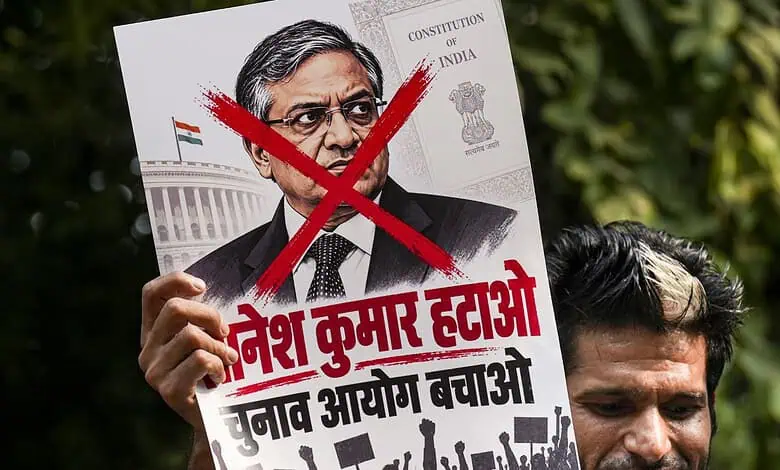
Protests outside the Election Commission’s office have revived an old question: who chooses the people who run India’s elections, and how do they decide? On Monday, the Supreme Court added a new chapter.
The Supreme Court on Monday sought a response within a week after hearing the pleas filed over alleged SIR irregularities. A bench headed by Chief Justice Surya Kant, while issuing the notice, refused to suspend Kumar at this stage, asserting that Commission decisions must be unanimous or by majority, and that if the response shows some were not, it would take those decisions back.
The matter reached the apex court after an Indian Express report said that the Commission took several decisions on the Special Intensive Revision (SIR) of electoral rolls without the concurrence of the other two Election Commissioners.
Among several petitions filed, one plea says Election Commissioners Sukhbir Singh Sandhu and Vivek Joshi recorded at least 14 objections between October 28, 2025, and August 14, 2026. These are allegations, and the Commission has yet to answer them in court. The court had earlier upheld the SIR itself as lawful. The present challenge is about how decisions were taken.
Outside court, thousands of youth and opposition supporters have rallied for three days, demanding Kumar’s resignation. An opposition march to the Commission is planned for Tuesday and a larger rally in Delhi on October 10.
The Law Behind It
Gyanesh Kumar is CEC under the 2023 law on Election Commissioners, which came into force on January 2, 2024, and scrapped the 1991 Act. The petitioners now want the Supreme Court to examine Section 18, the clause on how the three-member Commission reaches a decision, since it covers how the Commission makes its decisions.
Why The Act Is Disputed
As per the 2023 Anoop Baranwal ruling, appointments should follow the advice of a panel comprising the Prime Minister, the Leader of the Opposition and the Chief Justice of India, until Parliament made a law.
The 2023 Act kept a three-member panel but replaced the CJI with a Union Cabinet Minister nominated by the Prime Minister. Critics say that gives the government a built-in majority. The government’s position is that Parliament has the power to legislate on the matter.
The Supreme Court declined to stay the Act in March 2024, and Kumar became the 26th CEC on February 19, 2025.
On September 23, a two-judge bench split on whether to send the challenge to a five-judge Constitution bench. Justice Dipankar Datta said, prima facie, that the panel’s makeup appeared to give the Executive a veto and could weaken public confidence in the Commission’s independence. Justice Satish Chandra Sharma differed on the referral. The matter now rests with the Chief Justice.
Two Disputes, One Question
How commissioners are chosen and how they decide are separate court cases, but they share a thread. The Supreme Court will have to say how independent an election authority must be, and who guarantees it.