


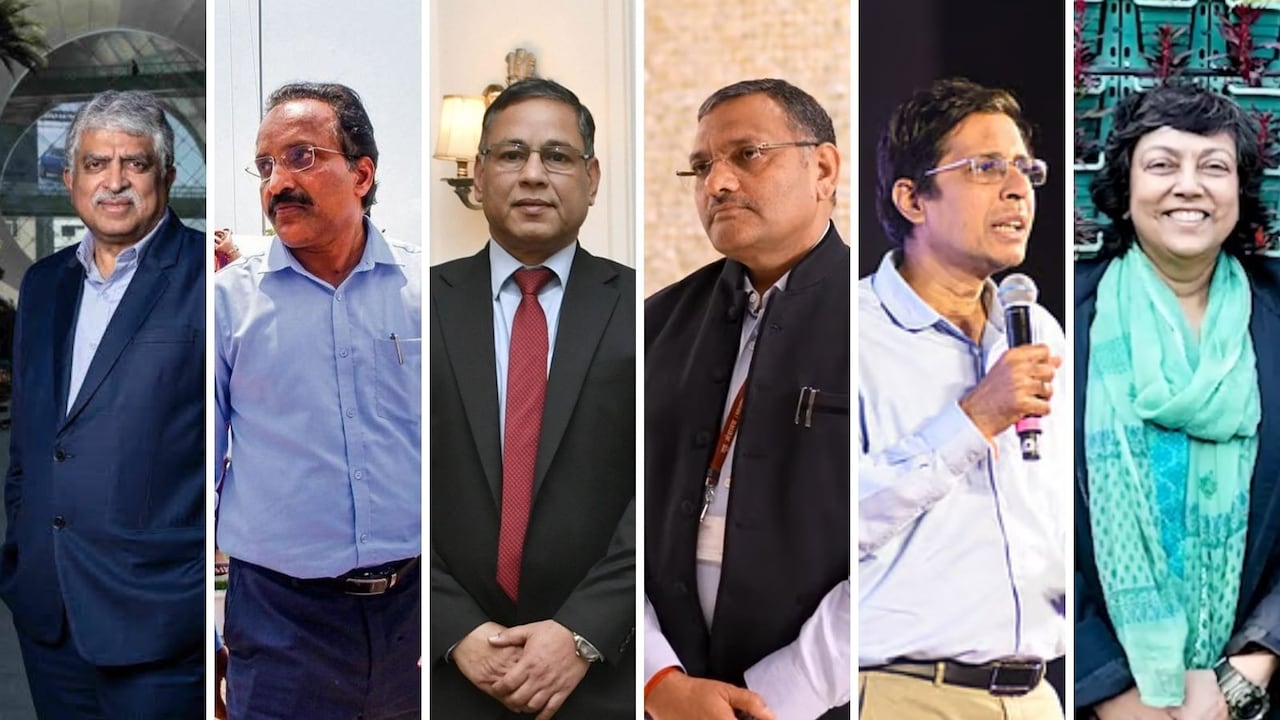
Six people. Five very different careers. One extremely overdue fix.That’s essentially the pitch behind the new task force the Centre has put together as 2026 saw paper leak one after another denting public faith in India’s competitive exams.
Rather than appointing career bureaucrats alone, the task force draws from technology, space engineering, intelligence, cybersecurity, education administration and somewhat unglamorous but probably most important- a logistics guy. logistics. That spread suggests the government sees this less as one failure and more as several — a leak can originate in a server, a transport truck, or a compromised insider, and the panel appears built to cover all three. No single official was ever going to solve this so the government has gone wide, and pooled in varied domain experts.
Nandan Nilekani — the technology lead
Leading the group is Nandan Nilekani, which surprised almost no one. He co-founded Infosys, sure, but the resume line that actually matters here is Aadhaar — he built it, more or less, as UIDAI’s founding chairman, at a scale that had never really been attempted anywhere. Encrypted platforms, identity checks, data protection at scale: this is Nilekani’s home turf, and it’s presumably why he’s the one steering the ship.
S. Somanath — the systems-thinking outsider
S. Somanath comes at this from a completely different angle — literally rocket science. As ISRO’s former chief, who made Chandrayaan-3 land on the moon, a mission with zero room for error. That kind of work does something to how you think about process — you start obsessing over redundancy, over checking the checkers. It’s not hard to see why that mindset is useful for an exam system where a single leaked paper can undo months of preparation for millions of students.
Tapan Kumar Deka — the intelligence angle
Then there’s the intelligence side of things, because leaks don’t just happen. They are organized with people from the inside earning profits outside. That’s Tapan Kumar Deka’s territory. He ran the Intelligence Bureau before retiring, and a physics postgraduate background gives him an unusually technical read on how these networks actually operate. He is expected to bring his counter-intelligence background to bear on identifying such networks and strengthening real-time monitoring.
V. Kamakoti — the cybersecurity expert
V. Kamakoti, IIT Madras’s Director, is the cybersecurity name on the list — microprocessors, information security, member on the National Security Advisory Board. If the reforms end up leaning hard on tech (they probably will), he’s the one making sure it doesn’t get hacked six months. As digital exam infrastructure expands, his role is expected to focus on hardening systems against cyberattacks.
Anita Karwal — the policy insider
Anita Karwal is the panel’s one purely institutional voice. A retired IAS officer who once served as Union Education Secretary, actually aware of the machinery of Indian education policy — curriculum, evaluation standards, how exam centres are regulated on paper versus how they actually run. A retired IAS officer of the Gujarat cadre she brings direct administrative experience within India’s education system, including curriculum policy and regulation of examination centres.
Amrit Lal Meena — the logistics fix
Necessary and almost forgotten but arguably the most practical appointment on the list: Amrit Lal Meena. Former Bihar Chief Secretary, former logistics secretary in the Commerce ministry — his job is going to be the boring stuff that actually causes most leaks. Question papers get compromised in transit and storage more often. GPS tracking, tamper-proof packaging, a proper custody chain- he is tasked with the physical security of question papers — an area officials claim to be most vulnerable for paper leaks.
Once submitted, the task force are expected to form the basis of broader reforms to India’s examination framework. For now, the panel’s makeup — spanning technology, security, intelligence and administration — offers an early signal of where the government believes the system has been most vulnerable.