


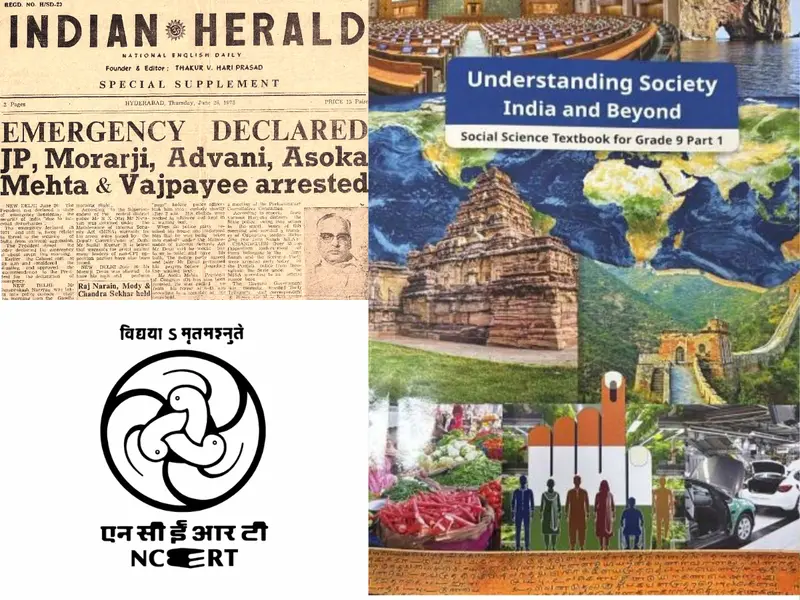
Fifty years later, the political draught that was just spoken off by grandparents’ now enters the education system. The NCERT has introduced the subject of the Emergency in its latest textbook, describing it as one of the most significant challenges faced by Indian democracy.
The chapter has been added to Class 9 social science textbook, called- ‘Understanding Society: India and Beyond’. As per reports, it examines the strength, evolution and changes of democratic governance in India.
For the first time, Indian students will now be able to read about the days of the Emergency that were largely spoken about by older generations. The move comes weeks after the country marked 50 years since the proclamation of the Emergency on June 25, 1975, a period widely recognised as one of the most controversial chapters in Indian history.
An official at the NCERT confirmed that this is the first time a section on the Emergency has been added to a Class 9 textbook. The inclusion marks a significant addition to the school curriculum, coming as the country recently observed 50 years since the declaration of the Emergency.
The textbook also highlights the contribution of faction leader and social reformer Jayaprakash Narayan, popularly known as Lok Nayak, in mobilising opposition to the Emergency. It explains how movements led by him brought together students, youth groups and citizens, particularly in Bihar and Gujarat, creating a broad-based campaign for democratic reform.
The chapter further notes that the outcome of the general elections held post Emergency demonstrated the resilience of the Indian democratic framework, as voters were able to express their views through the electoral process and bring about political change.
Beyond the Emergency, the textbook examines several contemporary challenges confronting democracy, including misinformation, fake news, poverty, regional divisions, social discrimination and gender equality. The objective is to help students understand the complexity of democratic governance in modern society.
Besides, a new section titled “Democracy and You” has been added to encourage students to engage with democratic values and understand their responsibility as civic citizens. The textbook focuses on democratic institutions, the role of media as the fourth pillar of democracy, voter participation, polling systems and grassroots democracy through examples of panchayats. To underline the scale of India’s democratic system, the textbook includes facts and figures on voter participation, polling infrastructure and political representation.
It also includes a section on women’s voting rights and reservation in local bodies. It uses case studies of grassroots democracy, including a panchayat in Gujarat and a women-friendly panchayat in Tripura, to demonstrate citizen participation in governance. A separate section has also been devoted to women’s voting rights and reservations in local bodies.