


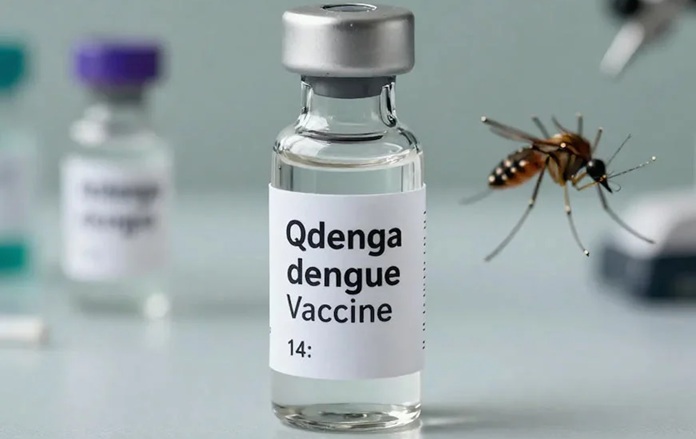
The Drug Controller General of India (DCGI) on Monday approved Takeda’s QDENGA, India’s first authorised dengue vaccine for people aged 4 to 60 years. It is being seen as a significant milestone in the country’s fight against one of its most widespread mosquito-borne diseases.
The approval makes QDENGA the first dengue vaccine authorised for use in India and allows it to be administered regardless of whether a person has previously been infected with dengue, without requiring pre-vaccination screening.
QDENGA is a tetravalent, live-attenuated vaccine designed to protect against all four dengue virus serotypes. It is administered as two subcutaneous doses of 0.5 mL each, given three months apart.
The vaccine is recommended by the World Health Organization (WHO) for use in dengue-endemic regions and has also received WHO prequalification, making it eligible for procurement through international agencies such as UNICEF and the Pan American Health Organization (PAHO).
According to Takeda, QDENGA has already been approved in 43 countries across Asia, Europe and Latin America, with more than 32 million doses distributed globally. It is part of Brazil’s National Immunisation Programme and is also available through public immunisation programmes in countries including Argentina, Colombia and Indonesia.
Dengue continues to pose a major public health challenge in India, which accounts for nearly one-third of the global disease burden.
According to the company, more than 113,000 dengue cases were officially reported in India in 2025. However, modelling studies suggest the actual number of infections may run into tens of millions annually due to underreporting.
With rapid urbanisation, changing climate conditions and widespread mosquito breeding, dengue has increasingly become a year-round health concern across several parts of the country.
The approval is based on Takeda’s global clinical development programme, which included 19 Phase I, II and III clinical trials involving more than 28,000 participants from dengue-endemic and non-endemic countries.
The pivotal Phase III TIDES (DEN-301) trial enrolled over 20,000 participants across eight countries and demonstrated an overall vaccine efficacy of 80.2% against virologically confirmed dengue one year after the second dose.
The study also reported 90.4% efficacy against dengue-related hospitalisation after 18 months. After 4.5 years, the vaccine continued to show 84.1% efficacy in preventing hospitalisation due to dengue.
According to Takeda, the vaccine has demonstrated sustained safety and efficacy for up to seven years across all four dengue virus serotypes.
The Indian approval was further supported by data from a separate Phase III clinical trial involving participants aged 4 to 60 years in India, which found the vaccine to be safe, well tolerated and capable of generating a strong immune response.
Mahender Nayak, Head of Intercontinental Markets at Takeda, said the latest long-term data demonstrated continued protection against dengue infection and hospitalisation across all four virus serotypes. He described the approval as an important step towards strengthening dengue prevention in India.
Takeda said it will now work with Indian regulatory authorities and healthcare stakeholders to support the rollout and availability of QDENGA across the country.