


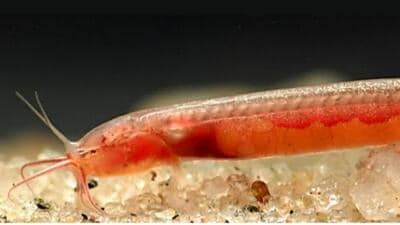
A team of ichthyologists, led by an international team of European, U.S. and Indian ichthyologists, has discovered an incredible new species of subterranean fish named Gitchak nakana, the first aquifer-dwelling (phreatobitic) fish to be ever described in Northeast India. The discovery was the first record of hitherto unknown underground fauna of this part of Asia. The results were released in the journal of Nature Portfolio, Scientific Reports, on February 26.
It was found in a dug-out well in Assam, and is of an entirely new genus. According to the scientific world, researchers refer to it as extremely anomalous as there is a total lack of a skull roof and the brain is just covered by skin on the back side. The fish also has no eyes – another typical adaptation called troglomorphy, as is usually observed with any organism that has developed in a dark and subterranean environment.
Although 300 or more species of subterranean fishes have been described in the world, less than 10 percent of these are found in aquifers, and thus their occurrence is uncommon and mostly by chance. Underground water-bearing structures known as aquifers represent a unique ecosystem containing special forms of life, such as invertebrates and some attentive species adapted to extreme darkness and scarcity of resources.
Gitchak nakana derives its name based on Garo language. Gitchak translates as red and the fish is very bright red in life, whereas nakana is the combination of words that mean fish and blind and this connotes that the fish has no eyes.
Researchers who worked on the project were based in Germany, Switzerland, and India, which indicates a great effort in developing the knowledge on underground biodiversity.
Join our whatsapp group for Latest updates
Click Here for Chhattisgarh News
Click Here for Entertainment News