


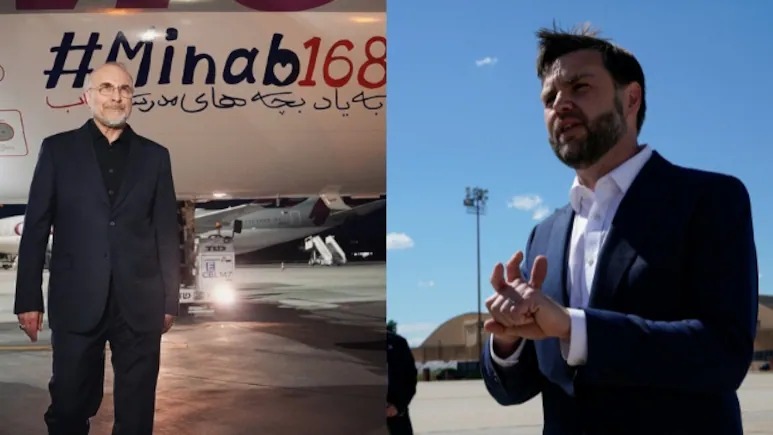
US and Iranian officials will return to Switzerland on Sunday to press on with hopeful negotiations for a new effort to develop the recently agreed ceasefire deal that ended four months of conflict raging across the Middle East.
The meetings follow a 14-point draft deal signed by U.S. President Donald Trump and Iranian President Masoud Pezeshkian that aims to freeze military activities and eventually reach a comprehensive settlement in 60 days.
The US team is headed by Vice President JD Vance and senior envoys Steve Witkoff and Jared Kushner. Among Iran’s top officials at their delegation is Parliamentary Speaker Mohammad Baqer Ghalibaf and Foreign Minister Abbas Araghchi, as well as other members of the country’s security, oil and financial fields.
In addition, Pakistani Prime Minister Shehbaz Sharif, Chief of Army Staff Asim Munir and some mediators from Qatar will be helping in the talks at the resort of Burgenstock in the Swiss town of Obburgen.
The main priority would be to push forward negotiations on Iran’s nuclear programme and to consolidate the tenuous ceasefire in Lebanon, Vance said before he left for Switzerland. He said he felt he could make strides on both.
Meanwhile, President Trump has gravely warned about the Strait of Hormuz, a key global energy shipping corridor. “Blessed are the people on vessels that pass through the strait during 60 day of cease-fire, they will not be charged a toll,” Trump said in his post on the message platform. If negotiations don’t reach a consensus, he said that the U.S. would have to have its own toll regime.
Iran’s Islamic Revolutionary Guard Corps (IRGC) stated that the strait had been shut down due to a renewed Israeli attack in Lebanon, prompting the warning. It was denied by the United States, which maintains that the sea lanes are not disrupted.
The talks are closely followed globally, as they could have implications for regional peace and international energy markets.