


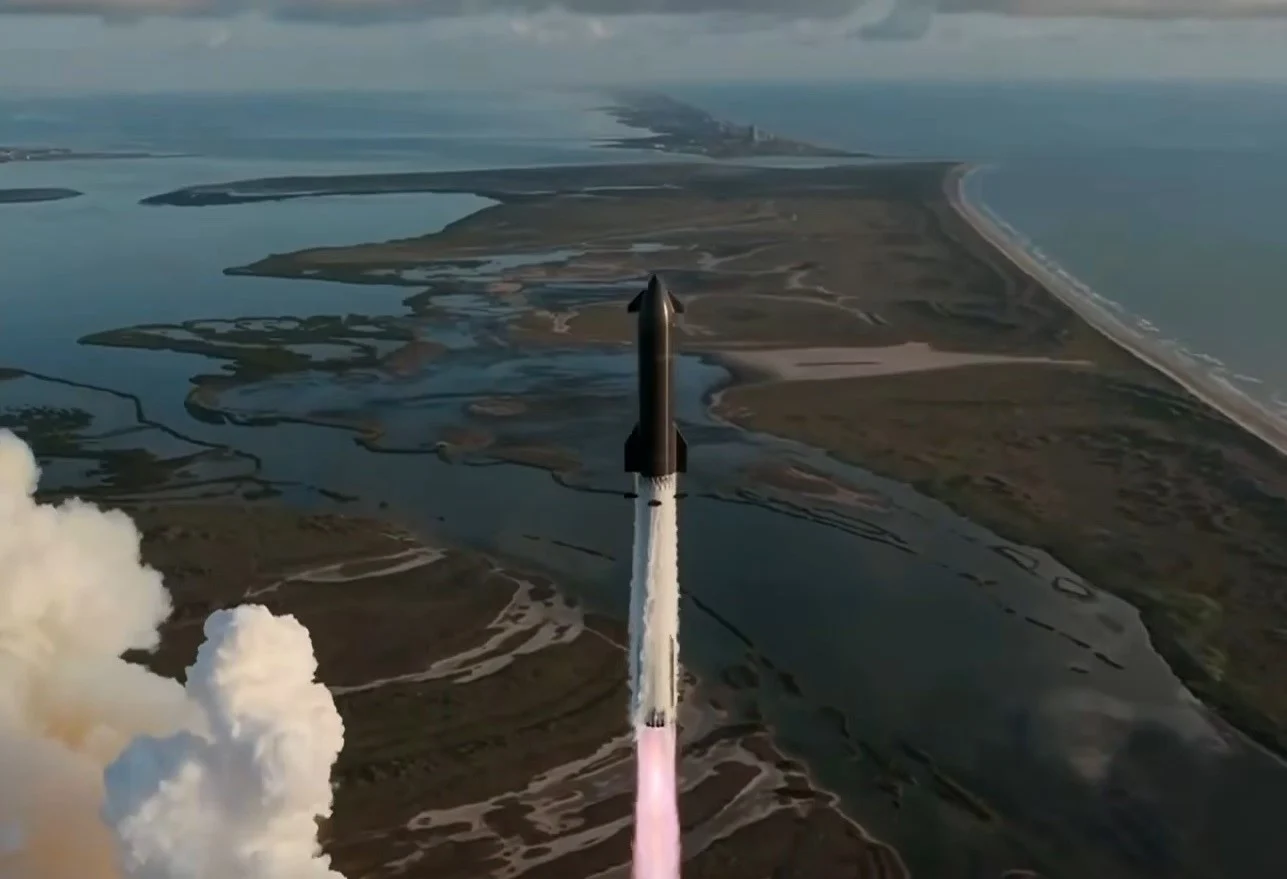
SpaceX successfully placed its Starship superrocket on its first orbital flight-that deployed operational Starlink satellites in orbit for the first time.
The over 400 foot giant rocket lifted off from its launch pad at SpaceX’s Starbase complex on the Texas coast at 7:00 a.m. CT on Monday and completed nearly two orbits. This was the 14th flight of the Starship test program, but all previous flights had been suborbital.
The 33 Raptor engines on Starship’s Super Heavy booster shut down prematurely. Despite the single engine failure, the climb to space proceeded as planned, and the booster executed a safe splashdown in the Gulf of Mexico.
The objective was achieved, and mission control declared Starship orbital, drawing cheers from SpaceX employees watching the live video feed.
During the mission’s key orbital phase, Starship’s satellite deployer worked like a giant Pez dispenser, pushing out 26 next-generation Starlink V3 satellites one after another at an orbital altitude of 116 miles.
SpaceX had previously deployed V3 satellites during a flight test in July, but because Starship did not reach orbit on that flight, the satellites re-entered the atmosphere and burned up after a series of tests.
The V3 satellites are heavier than the current Mini modules. They are designed to enable data download speeds of up to 1 terabit per second, which is about 10 times the capacity of SpaceX’s existing constellation of more than 11,000 satellites.
This additional capability will be key for SpaceX’s future direct-to-device services. To take full advantage of it, SpaceX will be transitioning to Starship from its workhorse Falcon 9 rocket.
Out of an abundance of caution, given the engine issue experienced during the ascent, SpaceX decided to shorten the mission from 10 hours. It then resorted to a backup plan, sending the upper stage to a Pacific Ocean splashdown north of Hawaii just three hours after launch.
The double splashdown was always part of the plan for the mission.
For the next Starship test flight, SpaceX is reportedly considering having the second stage return directly to its launch pad, where it could be caught by a pair of giant mechanical arms.
There are two Starship launch pads at SpaceX’s Starbase in Texas, and the firm is currently working on Starship launch facilities in Florida and Louisiana to accommodate what the company hopes will be a dramatic increase in liftoffs.
SpaceX also plans to use Starship for trips to the Moon, Mars and other destinations beyond Earth.
NASA is counting on Starship as well. Next year, the agency expects to test a Starship lander, as well as a Blue Origin Blue Moon lander and Artemis 3 mission, in preparation for a crewed landing on the Moon that could take place in early 2028.