


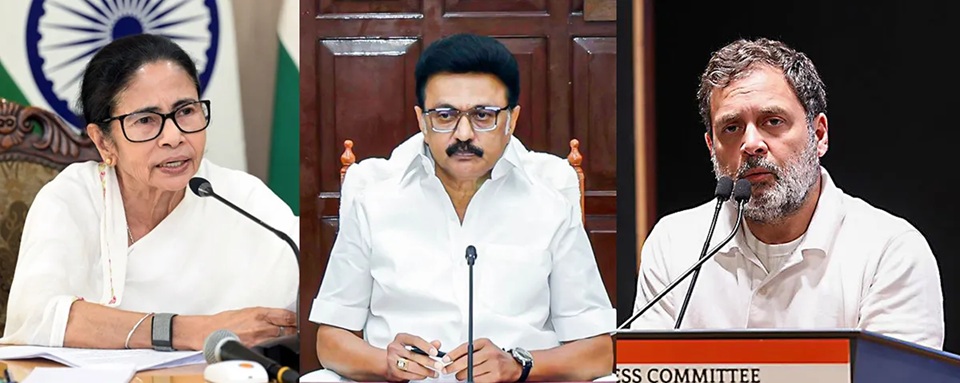
Just when the opposition was trying to show unity ahead of a crucial upcoming Parliament session, the DMK, Congress’ strongest ally in South, has opened a fresh front against Leader of Opposition Rahul Gandhi. The sharp criticism from one of the INDIA bloc’s most influential southern allies comes at a politically sensitive moment when the opposition alliance is already grappling with turbulence in West Bengal, preparing for a potentially contentious Parliament session and attempting to build a common strategy against the Centre’s proposed delimitation exercise.
Against that backdrop, the DMK’s unusually direct attack on Rahul Gandhi has triggered fresh questions about the unity within the India bloc. The escalation between the DMK and Congress was visible on two fronts. While the DMK’s IT wing mocked Rahul Gandhi on social media, the party’s official newspaper Murasoli published a lengthy editorial accusing the Congress leader of weakening opposition unity rather than strengthening it.
The criticism centred on Rahul Gandhi’s recent appeal for INDIA bloc partners to remain united against the BJP. The DMK argued that several alliance partners had, at different points, accused Congress of undermining their political interests, making such calls for unity difficult to accept without scrutiny.
The DMK editorial also revisited Congress’ break with the DMK in Tamil Nadu, where the party later joined the Vijay-led TVK government after contesting elections as part of the DMK alliance. The significance of the attack lies not merely in what was said, but when it was said.
The opposition is attempting to close ranks ahead of the upcoming Parliament session, where issues such as delimitation are expected to dominate discussions. Several regional parties, particularly from southern India, have expressed concerns that any population-based redistribution of parliamentary seats could alter the balance of political representation.
On this issue, the Congress and DMK have largely shared common ground in opposing any move they believe could disadvantage states that have successfully controlled population growth. At the same time, the opposition is dealing with growing uncertainty in West Bengal, where political developments involving the Trinamool Congress have added another layer of complexity to alliance management.
In such a scenario, public disagreements between major opposition players risk diverting attention from issues on which they are attempting to build a united front. For the BJP, the latest exchange may simply reinforce a long-standing argument that the opposition struggles to remain united beyond electoral arithmetic.
For the INDIA bloc, however, the challenge is more immediate. The alliance’s effectiveness in Parliament and its ability to coordinate on issues such as delimitation, federalism and institutional reforms may depend less on shared opposition to the BJP and more on managing growing distrust among its own partners.
The DMK’s criticism of Rahul Gandhi may be rooted in Tamil Nadu’s evolving political equations, but its impact extends well beyond the state. With Parliament set to reconvene and several high-stakes political battles on the horizon, the episode serves as another reminder that the opposition’s toughest negotiations may still be taking place within its own ranks.