


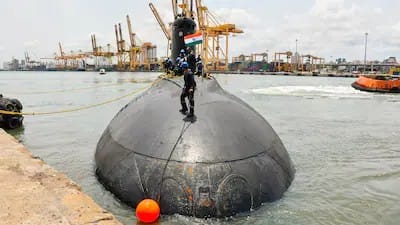
Sources say that India’s long pending project 75(I) submarine programme may be about to take off as the project is likely to be presented before the Cabinet Committee on Security (CCS) in coming days.
It is a programme for the Indian navy to build six advanced conventional submarines, with an estimated cost of approximately Rs 70,000 crore. The submarines are likely to be manufactured mostly in India by Mazagon Dock Shipbuilders Ltd (MDL) in Mumbai with German firm ThyssenKrupp Marine Systems (TKMS).
The project has languished for years due to numerous discussions between India and TKMS regarding commercial terms, technical aspects, and other considerations of the proposed contract.
If a clearance is given by CCS this will be a huge step forward and could commence the contract signing and construction process.
The programme will also feature an “expansion of technology transfer and domestic manufacture” element. For India, Project 75(I) is far more than a simple acquisition programme – it’s a way of bolstering the nation’s submarine-building, ship servicing, and upgrading skills, as well as its ability to build a new class of Indian-design naval vessels in the future.
Currently, TKMS is working to strengthen its ties with Indian companies ahead of the submarine project. Hyderabad-based VEM Technologies inked a memorandum of understanding with the German firm for modernization, development, construction and eventual integration of heavy weight torpedoes.
Part of the deal are VEM to be responsible for the integration and testing work on the Indian side, while TKMS subsidiary ATLAS ELEKTRONIK is on board. The partnership has later timegrown into a technology transfer partnership that incorporates a Make-in-India torpedo project.
TKMS is also in talks with CFF Fluid Control, Mumbai-based arms maker, for anti-submarine warfare (ASW) systems and have reportedly looked at more cooperations with Indian organizations, such as DRDO.
It is hoped the Project 75(I) submarines will have air-independent propulsion (AIP) that would enable them to stay underwater for much longer periods than their diesel-electric (DE) counterparts.
The submarines are also likely to be equipped with modern sensors, torpedoes and missiles and electronic warfare equipment, which will greatly enhance the Indian Navy’s underwater warfare capabilities.
The project, if approved, would be a major step towards India’s aim of increasing the size of its submarine fleet and developing a robust home defence manufacturing and technology sector.