


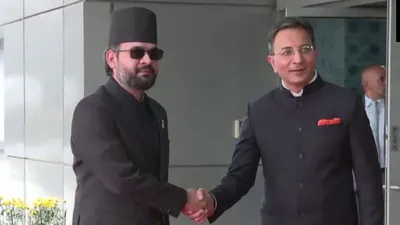
Nepal’s Prime Minister Balan de4ccShah arrived in New Delhi on Sunday evening on his maiden official visit to the neighboring country after taking charge in March 2026. The visit comes as an invitation of Prime Minister Narendra Modi, the Ministry of External Affairs said. His travel itinerary includes deleberations with prominent members of the government. He is scheduled to conclude his tour on Monday.
Shah and Modi on Monday are expected to hold extensive discussions focusing on strengthening bilateral ties and sharing perspectives on key regional and global issues of common concern.
Balen Shah is accompanied by a 34 member delegation including Nepal’s Foreign Affairs Minister, Shishir Khanal, Finance Minister, Swarnim Wagle, Chief Advisor to PM Kumar Bayjankar, and other senior officials of the government as per the press release by Nepal’s Foreign Affairs Ministry.
Earlier on Friday, during a press briefing, MEA spokesperson Randeep Jaiswal said that newer areas of cooperation such as startups, technology, innovation and sports are on the cards for discussion of the leaders.
Shah is further expected to meet External Affairs Minister S. Jaishankar and also call on President Draupadi Murmu. Ahead of Balan Shah’s trip to India, Kathmandu had also conveyed a proposal for a $2 billion economic package, including $1 billion grants as a part of efforts to move forward development projects and reconstruction of areas affected by the recent flash floods.
India, on the contrary, has proposed a joint vision document on economic cooperation, investment, transit, energy, digital connectivity, and health. The document will be unveiled during Shah’s visit.
Dating back to centuries-old historical, cultural, and geographical bonds, India and Nepal share ties underpinned by the 1950 treaties of peace and friendship and a 1751-kilometer open border, commonly encapsulated by the traditional adage “Roti Beti Ka Rishta,” symbolizing shared livelihoods and familial connections. The bilateral relationship of the nations is now evolving towards pragmatic economic, energy, and digital integration.