


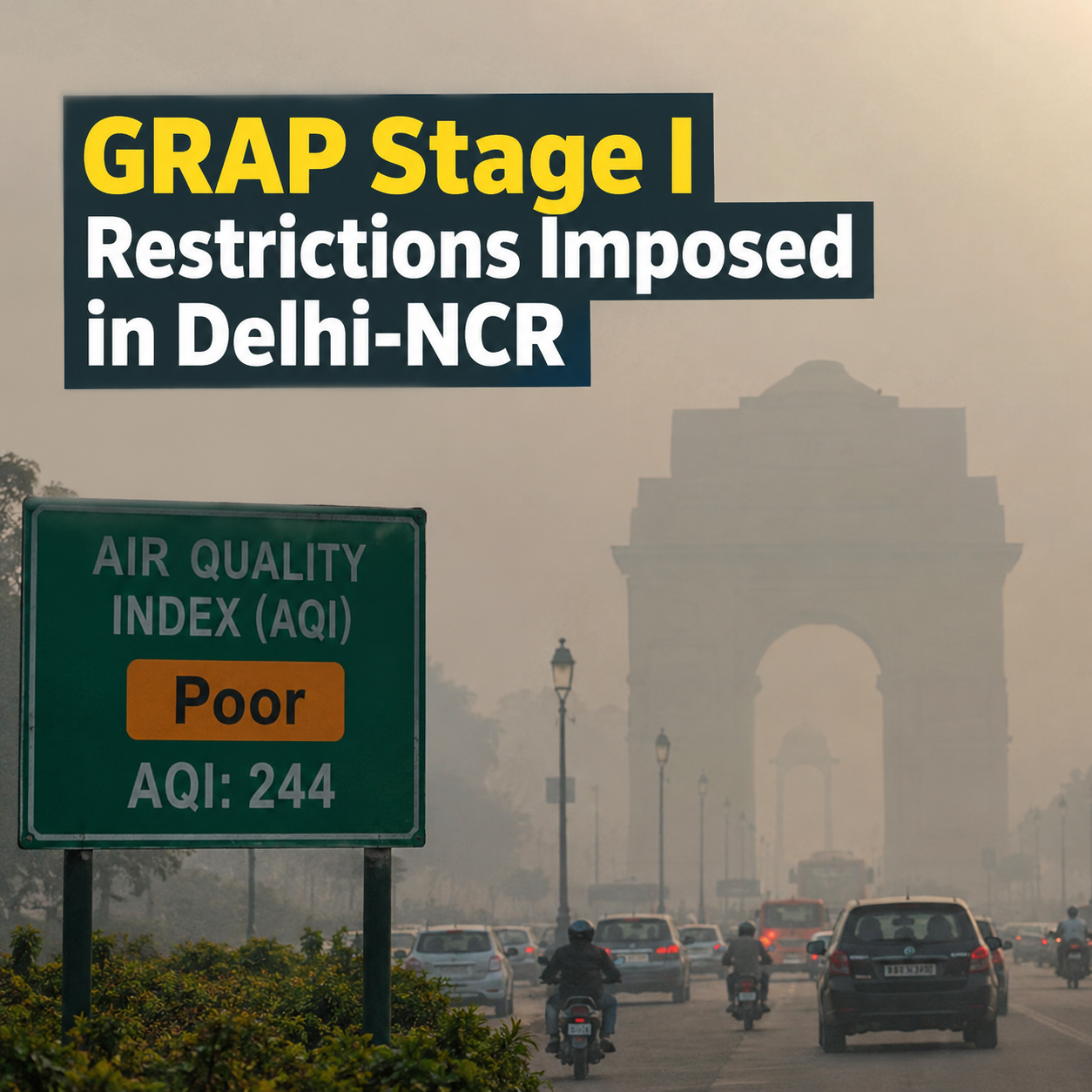
As the national capital braces for its annual toxic air pollution season, GRAP Stage I restrictions have been imposed in the National Capital Region for the first time this season. The Commission for Air Quality Management (CAQM), which is responsible for controlling pollution in Delhi and its neighbouring areas, cited an AQI of 244 at 2 pm as the reason for imposing the restrictions.
“The Air Quality Index (AQI) of Delhi, which was observed at 179 (‘Moderate’ Category) on 20.10.2026, has exhibited a sharp rise with AQI of 244 at 02:00 PM on 21.10.2026 (‘Poor’ Category). Further, the forecast by IMD/IITM has also predicted AQI to remain in ‘Poor’ category in coming days,” the CAQM said in a statement.
Claiming that this is the first time in years that GRAP has been implemented so late in the season, Delhi Environment Minister Manjinder Singh Sirsa said, “Delhi has been grappling with severe air pollution for several years. While the previous government continued to make excuses, we have adopted both short-term and long-term measures to tackle pollution. Public participation has played a crucial role in our efforts. We are implementing an 11-point action plan, with the Centre and the Delhi government working together to control pollution. Our focus is on dust mitigation, promoting electric vehicles, controlling vehicular emissions and identifying local pollution sources.”
Listing some of the measures under the restrictions, he said vehicles without a valid Pollution Under Control (PUC) certificate would not be permitted to refuel at fuel stations. Parking charges would be doubled across Delhi for such vehicles, except at metro parking facilities. Staggered working hours and work-from-home arrangements would also be incorporated for the Municipal Corporation of Delhi and government offices to restrict vehicular movement.
Outdoor construction and demolition activities will also be restricted. Demolition work will be stopped until November 30, while demolition activities will remain prohibited until January 31 next year. Open burning is strictly prohibited.
It was also stated that 608 anti-smog guns and 115 zero-mist spray units have been deployed across Delhi to control dust pollution. An integrated command and control centre has been established to monitor construction-related pollution, and AI-based traffic management is being incorporated to reduce vehicle emissions.
The restrictions come a day after the Delhi government released a pollution control plan to combat the pollution that engulfs the city during the winter season.
GRAP Stage I restrictions are imposed when the AQI is between 201 and 300, which is categorised as ‘Poor’. GRAP Stage II restrictions come into effect when the AQI stands between 301 and 400. GRAP Stage III applies when the AQI is between 401 and 450, which is categorised as ‘Severe’, while GRAP Stage IV comes into force when the AQI crosses 450, categorised as ‘Severe Plus’.