


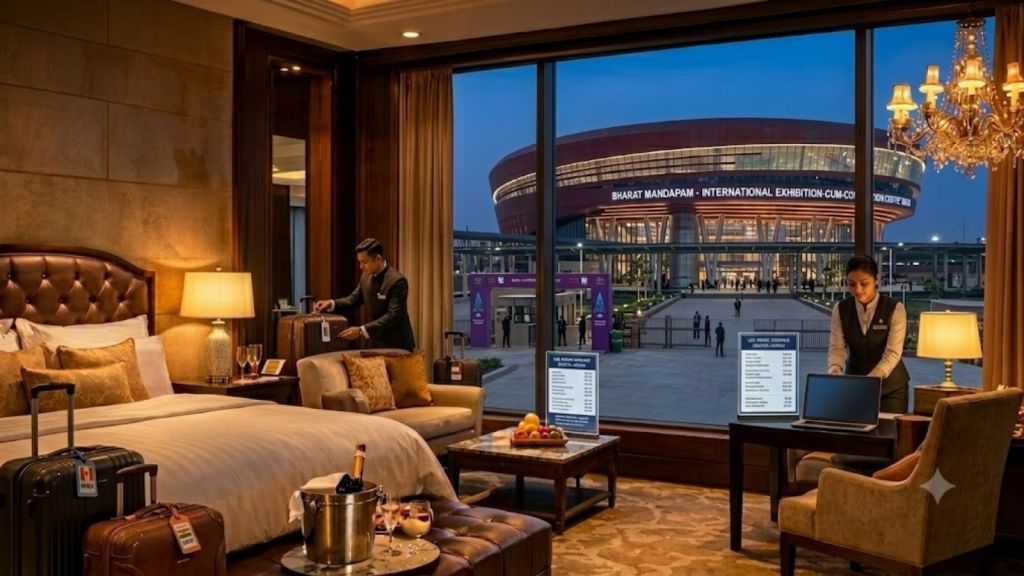
Booking a room at some of Delhi’s most luxurious hotels during the upcoming BRICS Summit could cost travellers a small fortune, with room tariffs surging sharply amid a severe inventory crunch.
With the 18th BRICS Summit scheduled for September 12 and 13, Delhi’s luxury hospitality market is witnessing a striking rise in demand. Security arrangements, advanced protocol requirements and bookings linked to the summit have absorbed a significant portion of the prime luxury inventory, leaving limited rooms for public bookings.
Hotels in and around central Delhi’s diplomatic enclave and other key locations are seeing particularly strong demand. From September 10 to 13, public reservation engines for several luxury properties show little or no room availability.
The Taj Mahal Hotel on Man Singh Road and the Taj Palace in the Diplomatic Enclave have completely blocked their premises for public bookings around September 11 and 12. The Taj Mahal Hotel shows no rooms available through September 13.
The demand pressure is visible as early as September 10, when tariffs at these properties have surged to around Rs71,470 to Rs72,000 per night, representing roughly a 3.5-times jump over standard baseline rates.
The Oberoi New Delhi is entirely sold out for September 11 and 12. Its rates climbed to around Rs 75,500 on September 9 and Rs 85,000 on September 10, while public availability remains open only on September 13, when rates return to around Rs 38,000.
The Leela Palace in Chanakyapuri shows a complete booking restriction for September 11 and 12, following a steep increase in tariffs to around Rs87,000 per night on September 10.
The Imperial on Janpath and The Lalit in Connaught Place are also fully blacked out for public bookings during the core summit window. The Lalit shows an extended period of unavailability from September 7 to September 15.
Even where room booking portals show availability, dynamic pricing and compressed event-driven demand have pushed tariffs to several times their usual levels.
The sharp increase in hotel tariffs could affect tourists, business travellers and families who have already planned trips to Delhi. Travellers may have to pay a significant premium for luxury properties, search for accommodation outside central Delhi, change their travel dates or choose more affordable hotels.
For Delhi’s hotel market, the upcoming BRICS Summit is emerging as a major demand driver. The impact is particularly visible in the luxury segment, where room inventory is limited and concentrated around key business and diplomatic areas.
With security requirements and summit-related demand taking up a substantial share of the available inventory, Delhi’s luxury hotels are seeing a rare combination of limited supply and sharply elevated prices — making a few nights in the capital during the summit potentially as expensive as an iPhone.