


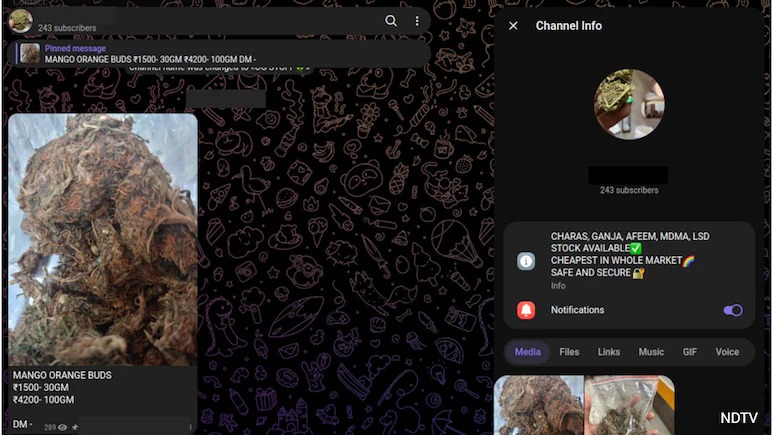
Police and cybercrime experts in Ahmedabad have come across the alleged online drug-selling racket using dark web platforms and Telegram channels. After the cyber police social media cell’s monitoring, the case was started on November 18 against the operators of five handles/groups of Telegram and 24 dark web onion links allegedly promoting banned drugs. The case was initiated on November 18 against the operators of five Telegram handles and 24 dark-internet onion links, which were allegedly promoting prohibited drugs, following monitoring by the cyber police social media cell.
The complaint is filed under the provisions of the Narcotic Drugs and Psychotropic Substances (NDPS) Act- 1985 and the Information Technology (IT) Act- 2000. Investigators are investigating ways in which the drug sellers are able to target the potential buyers via digital platforms and anonymous identities and online payment systems.
The cyber police officers employ the Tor browser and monitoring Telegram profile to look at the websites suspected of facilitating the criminal activity, according to the complaint. The officers recorded the advertisements and the instructions on ordering them in the presence of two municipal witnesses called panchas.
The flagged Telegram groups and channels allegedly encouraged the use of many banned and controlled drugs like cocaine, fentanyl powder, nembutal, pentobarbital, cannabis variants like mango kush and lemon haze, charas, ecstasy, ketamine, MDMA, LSD and opium.
Buyers were also expected to pay in advance via digital payment methods – this means transferring money along with cryptocurrency via a digital platform – not cash on delivery, the investigators noted, in instructions.
Outside of Telegram, investigators investigated 24 dark web onion domain links that were marking themselves online illegal drug catalogues. It was reported that the pages listed heroin, crystal meth, PCP, alprazolam, morphine, mandrax, amphetamine sulfate, cocaine and MDMA and ecstasy.
Several of the suspected storefronts included photographs of their products, prices, customer reviews, and shipping claims, among other things, which suggests how online platforms can be utilized for illegal drug sales.
Guaranteeing the security of digital evidence for investigation.
Investigators prevented the suspected platforms from deleting or changing information, obtaining 2.05 GB screen-recording video and lists of the monitored Telegram groups and dark web links.
The police also retrieved 38 screenshots and did have on-going copies of the digital evidence. A cryptographic hash, to preserve integrity of the evidence, and the evidence drivers were sealed for presentation during the litigation process.
The investigation now centers on tracing the operators, looking at digital payment trails, and examining the footprints, technical characteristics, that can be used to trace the network to determine the identity of the operators behind the potentially illegal online drug commerce.