


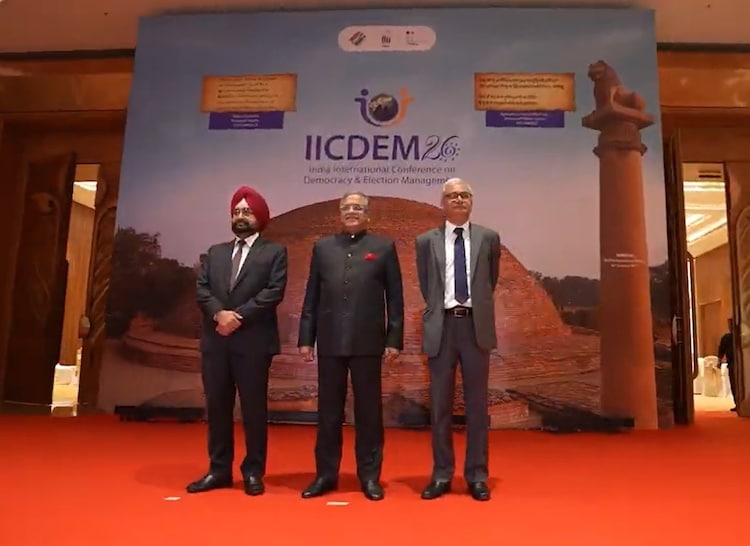
Despite the two election commissioners formally recording objections to several decisions of the Election Commission of India (ECI), the poll panel continued to present a united face at key election briefings over the past ten months.
Between October 28 last year and August 14, 2026, the election commissioners objected 14 times to various decisions, including the Special Intensive Revision (SIR) exercise. According to sources, the poll panel held only four joint briefings and also hosted the international conference on democracy and election management during the past ten months. However, at neither of those briefings did Election Commissioners Sandeep Singh Sandhu and Vivek Joshi voice their grievances or make their dissent known.
According to media reports, Sandhu and Joshi objected to decisions related to the deletion and restoration of names from electoral rolls, appeals against voter-related orders and access to ECI software where voter data is maintained. These objections, in most cases, were copied to Chief Election Commissioner Gyanesh Kumar, who has faced renewed criticism from the Opposition and calls for his resignation.
Reports indicate that the three commissioners held four joint briefings on key election-related issues on October 27, February 18, March 10 and March 15, even as objections were being recorded internally.
During the first media briefing held on October 27, the ECI announced the second phase of SIR, covering 12 states and Union Territories. CEC Gyanesh Kumar, in the presence of Sandhu and Joshi, addressed the media and said that the SIR exercise included poll-bound states such as West Bengal, Kerala and Tamil Nadu, while Assam was excluded on grounds of different criteria for determining citizenship.
The first issue was raised the very next day Sandhu objected to letters and orders being issued in the ECI’s name without a consentby the poll panel.
The second red flag raised by the election commissioners was restricted access to ERONet, the electoral roll database used by state-level election officers.
ERONet is software used by Electoral Registration Officers (EROs) in the states to add, delete or reinstate voter names in electoral databases. It was kept decentralised, enabling the ECI to address allegations of mass manipulation of electoral rolls.
The issue of non-accessibility was raised by Deputy Election Commissioner Sanjay Kumar on November 4, 2025, on the directions of Sandhu. The concern was raised weeks before the ECI was set to launch a revamped version of the software to bring all election-related portals under one roof.
Another letter was sent to Khanna on January 2, 2026, when the SIR exercise across 12 states had gained momentum. In the letter, Kumar wrote to Khanna to ensure that the IT system was designed in a manner that did not restrict the statutory rights of EROs.
On January 22, 2026, ECI Net was launched at the India International Institute of Democracy and Election Management (IICDM) in Delhi by all three election commissioners, who signed the Delhi Declaration that called for the purity of electoral rolls, the conduct of elections and the use of technology for capacity building.
However, months later, according to reports, the two election commissioners flagged the gradual centralisation of the electoral roll database. Sandhu also complained of being kept in the dark over new modules and portals being developed by Seema Khanna’s IT division.
Between January and March, three other media briefing were held by the election commissioners.
The second briefing was held in Guwahati on February 18, where the commissioners reviewed preparations for the Assam polls.
The three commissioners were together again in Kolkata on March 10. The meeting came as the electoral roll in West Bengal was under scrutiny, with more than 60 lakh names facing adjudication. The CEC said that no eligible voter would be removed from the list. He was also asked about the timeline for clearing the names that had been flagged, but no timeline was given.
Several months later, Election Commissioner Sandeep Singh Sandhu raised another issue in Bengal. He said 16 lakh appeals had been filed before tribunals concerning the inclusion of voters. In August, Sandhu wrote to officials seeking details on who had authorised the filing of those appeals on behalf of the ECI. In August, Sandhu also wrote to officials seeking to know who had authorised the filing of the appeals on behalf of the ECI.
The commissioners’ fourth and final joint media briefing was held in New Delhi on March 15. The ECI used the briefing to announce the schedule for the Assembly elections in Assam, Kerala, Tamil Nadu, West Bengal and Puducherry.
Sandhu and Joshi were also present, putting up a united front. However, the internal conflicts over SIR and ECI Net software continued.
How did ECI respond?
Responding to the objections submitted, the ECI characterised them as part of the normal decision-making process and maintained that decisions taken by the ECI over the past ten months were unanimous.
“Highlighting certain specific internal notes spread over the period of 10 months while overlooking the much larger body of approvals, decisions, instructions and initiatives gives only one part of the picture,” the ECI statement said.