


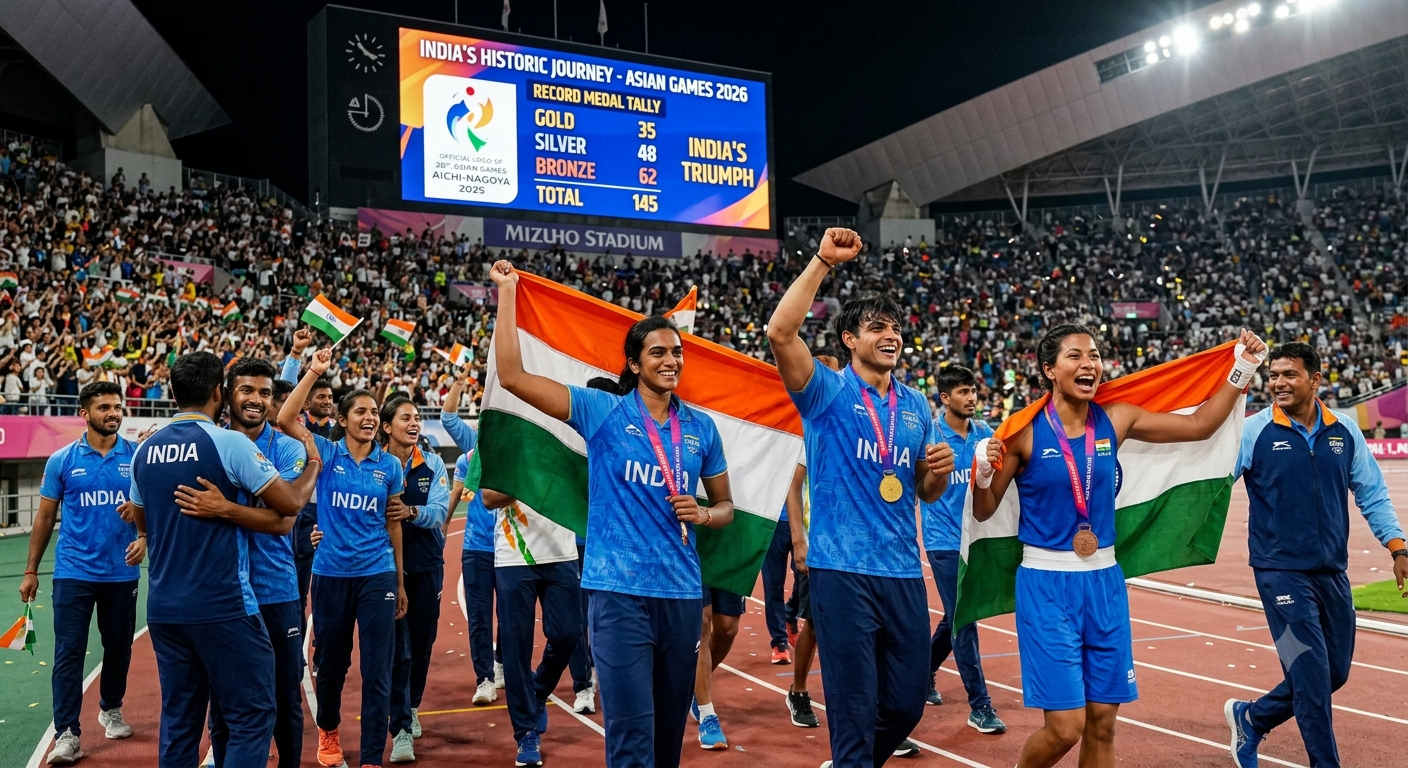
For a country of 1.4 billion people, India’s medal count at the Asian Games used to look strangely modest. That’s changed a lot over the last decade — and it’s still changing right now, with the 2026 Asian Games just getting underway in Aichi-Nagoya, Japan.
Where things started to turn
Rewind to 2014, Incheon. India came away with 57 medals and finished eighth — decent, but nothing to write home about. Four years later, in Jakarta-Palembang, things picked up.
69 medals was the total count India brought back, including 15 gold, 24 silver and 30 bronze. The best haul at that time still positioned at number 8.
Wrestling and shooting carried rhe load that year. Bajrang Punia and Vinesh Phogat, Saurabh Chaudhary and Rahi Sarnobat finished gold in their respective categories.
Then Hangzhou happened
2023 is where things really took off. At the Hangzhou Games, India crossed the 100-medal mark for the first time ever, finishing with 107 medals in total — 28 gold, 38 silver, 41 bronze — and jumped to fourth place overall, the country’s best-ever finish at these Games.
Sports ranging from hockey to wrestling. All categories showcased their talent. For the first time It didn’t feel like a handful number of players , carried the load of the whole contingen.
And now, Aichi-Nagoya 2026
The current Games have barely begun, but the pattern already looks familiar. India opened its account on Day One with two silver medals, both from shooting, both through Elavenil Valarivan — first in the team air rifle event, then individually.
The women’s hockey team staged a clinical performance in the group stage too, thrashing Uzbekistan 19-0, while the men cruised past Indonesia 13-0. Both the women’s cricket and table tennis teams also won their opening ties on day one.
Early days yet, but shooting, hockey and racket sports look set to be India’s biggest medal engines once again, just as they were in Hangzhou.
The bigger picture
What’s changed isn’t just how many medals India wins — it’s where they’re coming from.
A decade ago, the medal campaign was dominated merely by wrestling, shooting and athletics. But now medals arrive from archery, squash, kabaddi, sailing, rowing, tennis and even bridge.
That spread matters more than any single gold, because it points to real depth rather than a few standout athletes holding the whole show together.
The next fortnight in Aichi-Nagoya will tell us whether India can go past its Hangzhou high of 107 medals — and maybe, finally, break into the top three.