


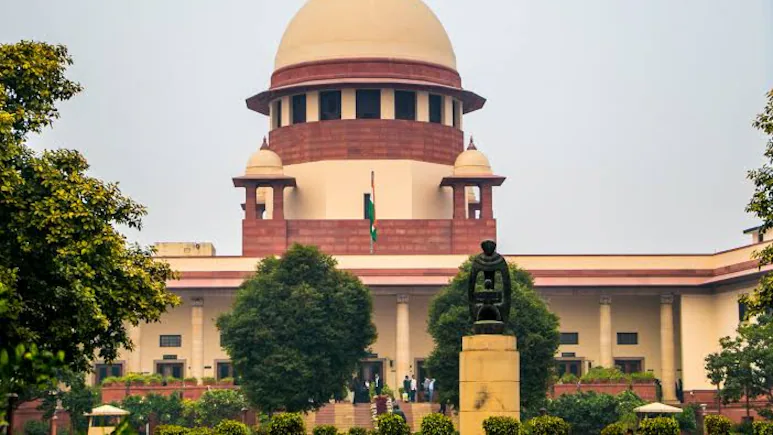
The Supreme Court on Tuesday ruled that a “conscientious objector” cannot be held liable for not singing Vande Mataram and asked the government to draw lessons from its previous decision in 1986 protecting schoolchildren from being forced to sing the national anthem due to any reason.
It is believed that the three-judge bench presided by the Chief Justice of India Surya Kant is considering a petition by Carnatic singer T M Krishna against the directions issued by the Ministry of Home Affairs regarding the Vande Mataram and the 2026 amendment to the Prevention of Insults to National Honour Act, 1971.
SC Refers To 1986 Bijoe Emmanuel Judgment
It was the consideration of the court that the principle enunciated in the past case of Bijoe Emmanuel vs State of Kerala of 1986 would apply to the amended law. If so, the Supreme Court covered the case of three school children standing in reverence during the national anthem, but whose faith leads them to not sing the anthem.
The bench was neither ruling on the content of the national song nor the number of stanzas to be recited, it said. Justice Bagchi said while the home rule government ought to decide what be its National song, singing it to the tune of someone’s feeling or conscience would not land a life sentence on anyone.
The court has asked the Centre to respond to Krishna’s petition, noting that the constitutional protection it is looking for is not moot in the face of the amended law as the case of Bijoe Emmanuel stands.
Petition Challenges Six-Stanza Requirement
The requirement of the six stanzas of Vande Mataram to be used as the official version is a point that is challenged by Krishna in his petition. It also challenges the provision that allows for penalization for “disruption” or “prevention” of intentionally singing the nationalism anthem.
Under the provision, up to three years’ incarceration and fines are provided in cases that fall under the provision. Krishna’s counsels maintained that the measures involved issues of conscience, speech and expression, religious freedom, equality and secularism.