


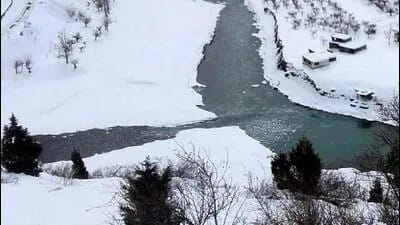
The Central Himalayan glaciers in Uttarakhand are melting at a rate of 23.23 metres per year on average, and with some glaciers losing ice at a rate of up to 88 metres per year, the study of observations and satellite imagery over 35 years has found.
The study titled “Time-dependent assessment of glacier recession in the Indian Central Himalaya,” has investigated the changes in glaciers from 1990-2024. It was determined that the rate of ice mass loss on individual glaciers is affected by their time series, nucleation and morphological features, along with topography and changes in temperature.
The study also revealed the rise of the glacier accumulation-melting limit (ELA) since 2000, by almost 500 metres in some sections of the study area. The results appeared earlier this month in Discover Geoscience.
The study was carried out by Manish Mehta (Wadia Institute of Himalayan Geology, Dehradun); Jyoti Kumari, Girish C Kothyari and Atul Kumar Patidar (University of Petroleum and Energy Studies, Dehradun).
The team, however, identified big differences in retreat speed of the individual glaciers. Long-term (relatively stable) and heavily debris-bound glaciers, such as the Bhagirathi Glacier (Uttarkashi) and Satopanth Glacier (Chamoli) found to be retreating around 3.7 metres per year.
An even higher retreat rate was observed in Khatling Glacier in the Bhagirathi valley of Tehri Garhwal with a range of up to 88 metres per year. The team believes the differences are due to glacier properties, debris cover and topography and climatic conditions.
The results indicate that glaciers are not changing at the same rate over the Central Himalaya and give a long-term perspective of the changes in high-altitude glaciers in the last 30 years.