


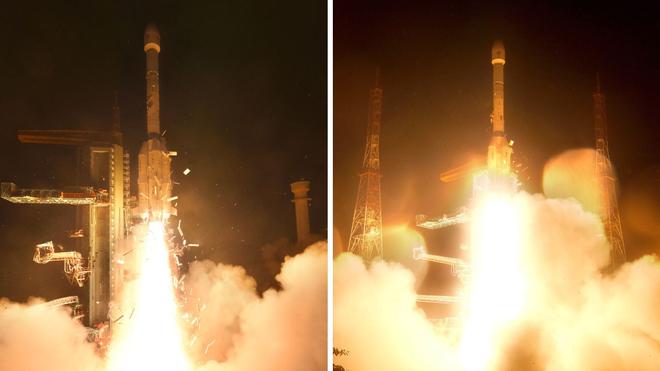
The successful launch of ISRO’s GSLV F7 carrying EOS-05 drew praise from leaders across the political spectrum of India. Prime Minister Narendra Modi, Union Minister Jitendra Singh, Home Minister Amit Shah and even the party in opposition congratulated the space agency’s scientists and engineers.The EOS-05 satellite was successfully placed in the intended sub-geosynchronous transfer orbit, about 18 minutes after it lifted off from the spaceport
PM Modi, taking to his X handle, described the mission as an outstanding achievement and a proud moment for our nation. His message reflected “excellence, innovation and growing capabilities” of India’s space sector.
He also highlighted the growing partnership between ISRO and Indian industry, saying it was adding greater strength and scale to the country’s space program. The launch was particularly significant for ISRO after the unsuccessful PSLV-C62/EOS-N1 mission in January. This EOS-05 becomes the agency’s first successful orbital mission in the current financial year.
After the successful launch of EOS-05, ISRO chief Dr. V. Narayanan on Friday announced that rigorous and systematic efforts are being made to launch the first uncrewed Gaganyaan mission within this year.
According to officials, Dr. V. Narayanan said the launch of the Earth Observation Satellite GSLV F-17 EOS-05 marks ISRO’s first success in this financial year, adding that the reward for hard work is more work. Consequently, the ISRO team, in collaboration with industries and organizations, is diligently working on the initial uncrewed Gaganyaan mission.
As per sources, ISRO plans to execute seven launches between September this year and March 2027, which includes the G1 mission of the Gaganyaan initiative, the first flight without crew.
Earlier this year, the Indian Space Research Organization announced the successful completion of three significant tests in concern to the systems for the Gaganyaan crew model.
The initial test focused on guaranteeing that the crew module maintains an upright position following its splashdown in the ocean, for which a cold gas-based uprighting system was developed and subsequently tested. Following the success of the test, ISRO chief Dr. V. Narayanan said that the Gaganyaan mission is progressing steadily, with nearly 90 percent of the development work being completed.
The GSLV F17 lifted from the second launch pad at the Satish Dhawan Space Center in Sriharikota at 2:55 IST on September 4th. The rocket successfully placed the 2367 kg EOS-05 into sub-geosynchronous transfer orbit. This is India’s first imaging satellite designed to operate from geosynchronous orbit, nearly 36,000 kilometers above Earth. This position will allow it to repeatedly observe larger regions and strengthen India’s Earth observation capabilities.