


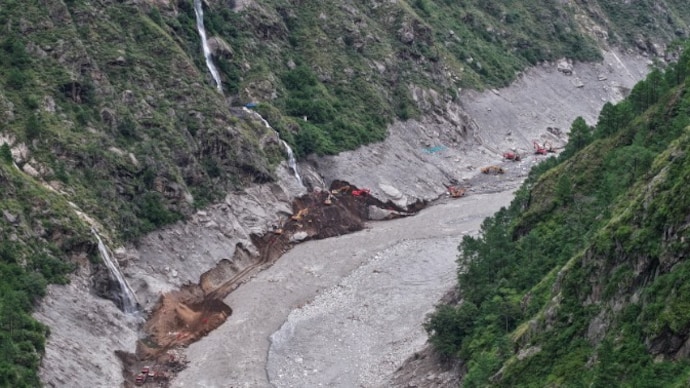
Rescue workers continued efforts to reach people trapped inside hydropower facilities as the death toll from the devastating floods and landslides crossed 1,270, with thousands still missing, authorities said on Thursday.
Earlier today, an earthquake of magnitude 5.0 struck Tibet, a week after the devastating floods. The quake highlights the continuing seismic and geological risks in the Himalayan region, which is prone to earthquakes, landslides, glacier-related events and other natural hazards.
According to the German Research Centre for Geosciences (GFZ), the earthquake occurred at a depth of 10 kilometres. There were no immediate reports of damage or injuries.
Nepal’s National Disaster Risk Reduction and Management Authority (NDRRMA) said 1,252 bodies had been recovered, while the total number of missing people in the country stood at 4,216. Hundreds of workers are believed to be trapped inside hydropower plants, including some inside tunnels, near Nepal’s border with China.
In neighbouring Tibet, Chinese authorities have reported 21 deaths and 541 people missing.
Families of those affected have gathered at rescue sites, hoping to receive news about their loved ones as rescue teams continue to arrive. Forensic teams have also been deployed to identify bodies that are now nearing decomposition.
Since the disaster, China has reopened the road to Tibet’s Gyirong border crossing, which was destroyed by a wall of water and debris. The reopening has allowed heavy machinery to reach some of the worst-hit areas for the first time.
China’s official list of those missing includes 104 Nepali citizens, 49 Indians and 33 Latvians believed to have been travelling in two tourist groups. Most of the missing Indians were pilgrims visiting Lake Mansarovar and Mount Kailash, two important Hindu pilgrimage sites in Tibet.
Meanwhile, Nepal estimates that around 20,000 houses need to be built near its border with China. Officials plan to rebuild the homes in safer locations for families affected by the disaster.
More than 9,300 Nepali soldiers have been deployed in rescue operations across the affected districts.