


FSSAI approaches court for Red warning labels on packaged food. Here’s what that actually means.

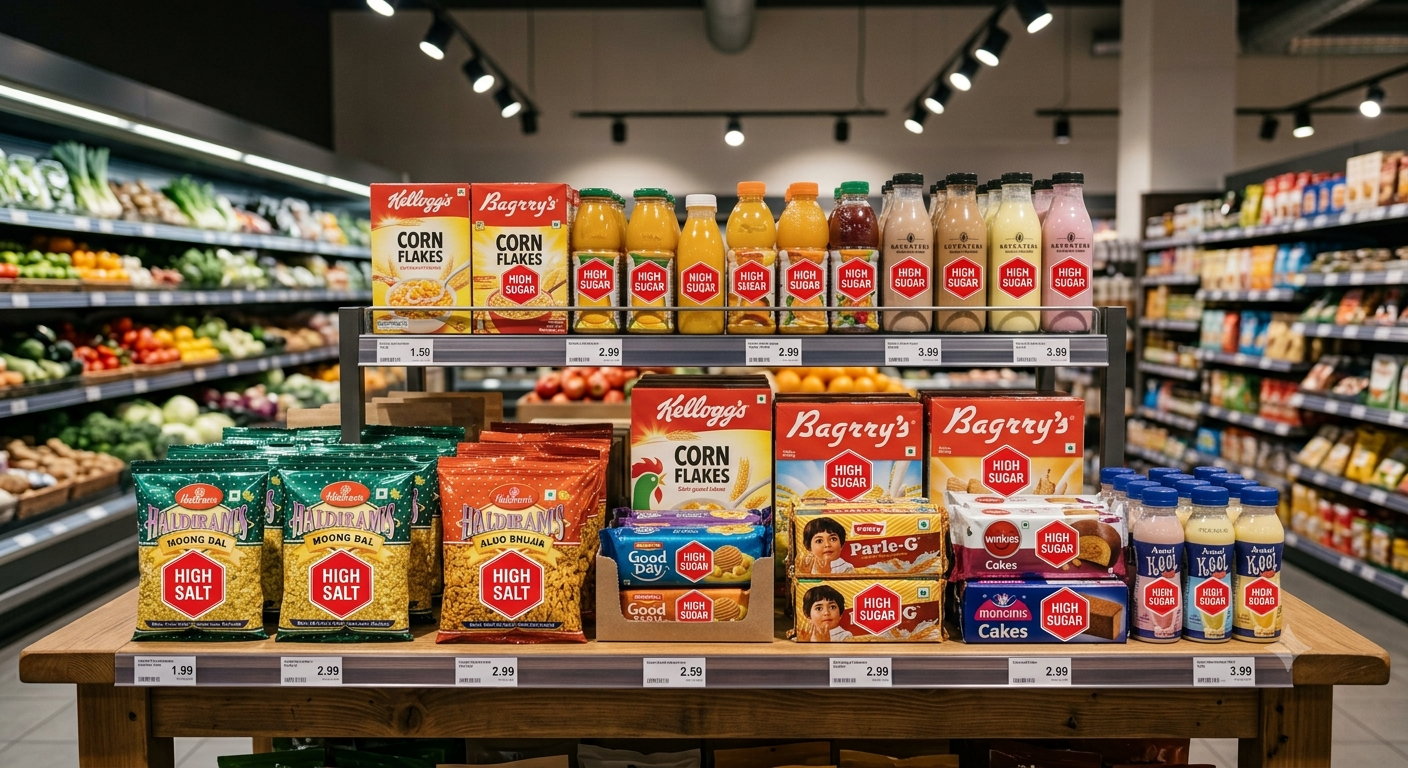
If you’ve ever picked up a packet of chips or a fizzy drink without a second thought, that might be about to change. FSSAI has told the Supreme Court it’s planning red, hexagon-shaped warning labels for packaged foods loaded with sugar, salt, or saturated fat — and the idea is simple: make the potential health risks impossible to miss.
So what exactly is being proposed?
Any packaged product containing more than two of the specified nutrients — added sugar, added saturated fat or salt — would carry a bold red warning on the front of the pack. Depending on what is high, the label would mention high fat, high sugar, high salt or highly sweetened beverage.
This means consumers would no longer need to dig through the fine print on the back of a packet to get an idea of where a product stands on the health scale.
Why hexagons, and why now?
The proposed thresholds are based on the Dietary Guidelines for Indians 2024, prepared by the ICMR’s National Institute of Nutrition, giving the proposed system a scientific basis for determining where the warning line should be drawn.
The Supreme Court has also been pushing for action on front-of-pack labelling, which has remained stuck in the rule-making process for years.
A bench of Justices J.P. Pardiwala and J. N. Chandrachud, on August 13 questioned whether the government wants people to be healthy, expressing frustration over the delay in introducing front-of-pack warning labels.
The case itself began with a public interest petition filed by the NGO 3S and Our Health Society.
Will every product get flagged?
Not quite. The proposal is still in the pipeline, and FSSAI has suggested exemptions for single-ingredient foods and products that are naturally rich in these nutrients. These include ghee, edible oil, sugar, jaggery and honey.
The reasoning is that warning labels are intended to help consumers identify processed foods high in unhealthy nutrients, rather than products that naturally contain these nutrients.
Is this happening tomorrow?
Not yet. Nothing is mandatory at this stage.
FSSAI has clarified that the proposal must first go through the formal rule-making process before any changes become mandatory. The regulator is also considering a phased rollout, which would give food companies time to reformulate their products rather than forcing them to make sweeping changes overnight.
Why it matters
Countries such as Chile and Mexico have already introduced similar front-of-pack warning systems, with evidence that such labels can influence consumers towards healthier choices.
If India follows through with the proposal, that red hexagon could become a prominent feature on supermarket shelves — and potentially have a bigger influence on what consumers put in their shopping carts than traditional advertising campaigns.