


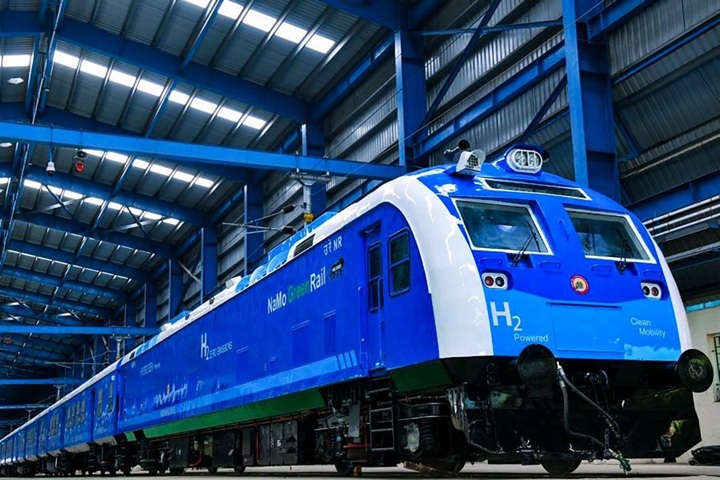
Prime Minister Narendra Modi will inaugurate India’s first hydrogen-powered train from Haryana’s Jind on July 17. The pilot service between Jind and Sonipat marks a major step in Indian Railways’ clean energy transition and India’s entry into a select group of nations exploring hydrogen-powered rail transport.
The launch is being seen as a significant milestone for Indian Railways’ clean energy transition, aligning with India’s broader commitment to energy efficiency and its net-zero carbon emission goals.
The Jind-Sonipat railway section has been selected as the pilot corridor for India’s first hydrogen-powered train. To support operations, an indigenous hydrogen storage and refuelling facility has been established at Jind.
The Petroleum and Explosives Safety Organisation (PESO) has granted the required licence for storing and dispensing compressed hydrogen gas at the facility.
According to the government, the project reflects Indian Railways’ commitment to innovation and environmentally sustainable transportation while reducing dependence on conventional fossil fuels.
With the launch, India joins countries such as Germany, Japan, China and the United States that are testing or operating hydrogen-powered trains.
Hydrogen rail technology remains at an early stage globally, with only a limited number of countries adopting the technology for commercial or pilot operations.
Hydrogen fuel cell technology generates electricity through a chemical reaction using hydrogen, producing only water vapour as a by-product, making it a cleaner alternative to diesel-powered rail systems.
Indian Railways has installed a hydrogen compression system for refuelling operations along with technical support and critical spare components to ensure reliable functioning. A standby compressor unit has also been provided.
The hydrogen facility has been equipped with hydrogen leak detectors, flame detectors and other safety sensors, which will undergo regular inspections and maintenance. Operation and maintenance manuals approved by the Research Designs and Standards Organisation (RDSO) have also been prepared.
The government said comprehensive safety protocols have been implemented at the maintenance facility in Shakurbasti, including round-the-clock monitoring of the hydrogen refuelling system, deployment of trained personnel, regular safety audits and scheduled maintenance.
During the initial phase, trained technical staff will travel with the train to ensure smooth and safe operations.