


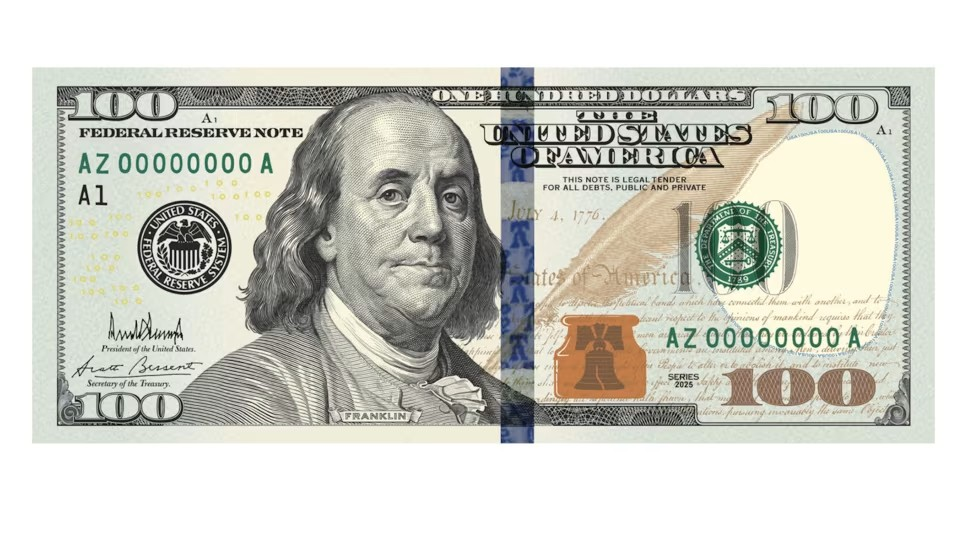
US President Donald Trump and Treasury Secretary Scott Benson on the occasion of the United States’ 250th anniversary, promoted a $100 bill featuring Trump’s signature, calling it as a recognition of nation’s history and economic strength.
On Saturday, Bennett shared an image of the new $100 bill on X after Trump posted it on Truth Social, showing the redesigned note featuring both Trump and Treasury signatures. Praising the administration’s economic agenda, Bennet wrote, “Under President Trump’s leadership, we are on a path towards unprecedented economic growth, lasting dollar dominance, and fiscal strength and stability.”
Welcoming the roll out, he added, “There is no more powerful way to recognize the historic achievement of our country and President Donald J. Trump than US dollar bills bearing his signature.” According to Scott, it is appropriate that this historic currency was issued at the semiquincentennial. The semiquincentennial refers to the 250th anniversary of the US independence, marking 250 years of the founding of the United States, which was signed in 1776.
This is for the first time that a U.S. bill holds sign of a president. Traditionally, Dollars have the signature of U.S. treasurer and the treasury secretary.
Brandon Beach, the treasurer of United States, also welcomed the development, saying the redesigned notes are expected to get into circulation very soon.
The redesigning of the U.S. currency bill represents a departure from the longstanding practice involving U.S. paper money, although Treasury secretaries and U.S. treasurers routinely have their signatures printed on the banknotes. Sitting presidents appeared only on circulating paper currencies are either in portraits or in the signature. Once the Bureau of Engraving and Printing completes the production, the notes are expected to enter the circulation through the Federal Reserve.
However, the bill faced criticism from the Congress and has given a divided public opinion. Treasury officials argued the inclusion of Trump’s signature is allowed under the Circulating Collectible Coin Redesign Act of 2020, a law that was signed during Trump’s first administration, which allows the administration to circumvent the restriction on an occasion such as the semiquincentennial.