


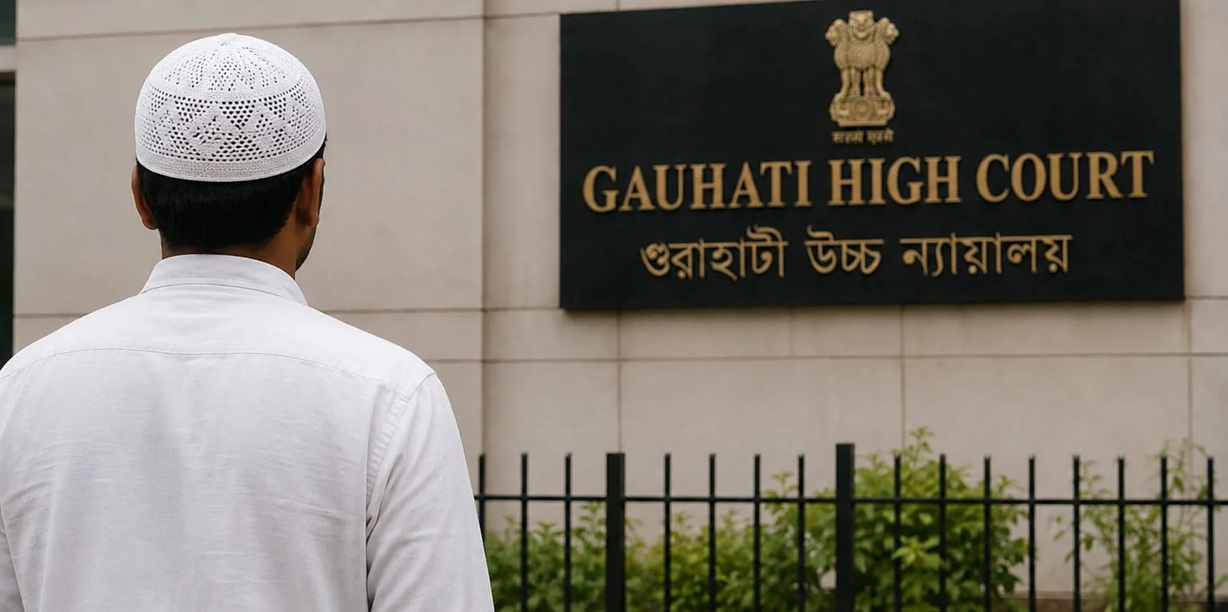
The debate around citizenship has resurfaced days after the Centre reiterated that an Indian passport is a travel document and not conclusive proof of citizenship. Adding a fresh legal dimension to the issue, the Gauhati High Court has upheld a Foreigners’ Tribunal order declaring an Assam man a foreigner, ruling that the documents produced by him were insufficient to establish his claim of Indian citizenship.
The HC judgment comes at a time when questions surrounding citizenship verification have once again entered public discourse following the Ministry of External Affairs’ clarification that a passport facilitates international travel but, by itself, does not determine citizenship status.
A division bench of Justices Kalyan Rai Surana and Shamima Jahan dismissed the petition filed by Aminul Hoque, observing that he failed to discharge the burden of proof required under Section 9 of the Foreigners Act, 1946. Under the law, the responsibility of proving Indian citizenship lies with the person against whom proceedings are initiated.
The court observed that although Hoque produced 15 documents, including records from the 1951 National Register of Citizens (NRC), electoral rolls, a 1973 land deed, a school certificate, PAN card and Elector’s Photo Identity Card (EPIC), the evidence was not sufficient to establish that he was an Indian citizen.
Hoque argued that he was an Indian citizen by birth and that his family’s names had appeared in the 1951 NRC and electoral rolls over several decades despite displacement caused by erosion along the Brahmaputra River. He also contended that differences in the spelling of names across official records were clerical errors and should not be treated as grounds to doubt his citizenship. His counsel further argued that computer-generated NRC records should be accepted as reliable evidence.
However, the Foreigners’ Tribunal found inconsistencies in the records, including variations in ages recorded in electoral rolls and difficulties in establishing a continuous family linkage. It also noted that the documents related to three different villages, weakening the claim of a single continuous lineage.
The High Court agreed with the Tribunal’s findings, holding that there was no illegality or perversity in its assessment and dismissed the petition.
The ruling assumes significance against the backdrop of the Centre’s recent clarification that an Indian passport is not a citizenship document but a travel document issued under the Passports Act. The government has maintained that citizenship disputes are determined under the Citizenship Act and other applicable laws, with documentary evidence assessed on a case-by-case basis.
The High Court’s decision reinforces that position, reiterating that citizenship claims are ultimately decided on the basis of legally admissible evidence and that the burden of proof remains on the individual under the Foreigners Act.
The verdict also comes amid continuing criticism of Assam’s Foreigners’ Tribunal system. A 2025 report by the National Law School of India University and Queen Mary University of London questioned the functioning of the tribunals, alleging that documentary and oral evidence is often rejected without adequate safeguards and calling for structural reforms to ensure fairness and due process.
The latest judgment is likely to add fresh momentum to the ongoing political and legal debate over citizenship verification, documentary proof and the functioning of Foreigners’ Tribunals in Assam.