


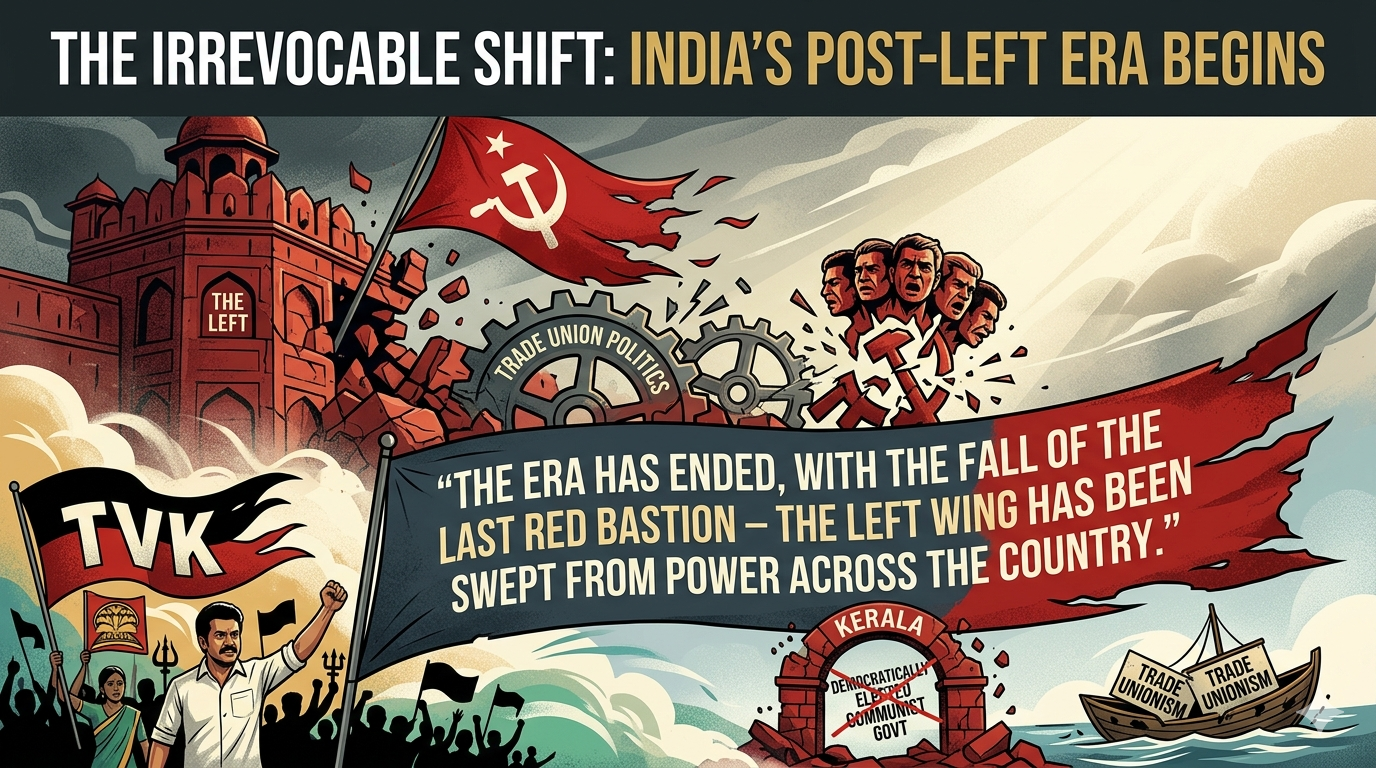
The 2026 assembly elections have irrevocably shifted politics permanently India’s longstanding ideologies. While the headlines in the south have been dominated by actor-politician Vijay’s TVK dismantling the Dravidian monopoly in Tamil Nadu. The bigger story is the unprecedented shift in Bengal governance and the final breath of left-wing governance in India.
Five decades on the ground, “the Left” maintained a strong foothold in state legislatures serving as stalwart administrators across states. It served as a fixture of the Indian identity, a stubborn voice for the working class that once ruled New Delhi. That era has now come to an end, with the fall of the last red bastion- the Left Wing has ben swept from power across the country.
Early trends indicated the left being taken down from Kerala-the first state that the party ruled. Kerala is the first southern state to have a democratically elected communist government and the last to have communist governance. The downfall of the Left in Kerala marks an end of an era defined by trade union politics and failure to address upgraded caste and gender concerns. A movement that ran on communist framework.
Meanwhile, in West Bengal, the Bharatiya Janata Party (BJP), once viewed as a perpetuator in the state, has claimed victory for the first time. This isn’t just a change in administration; it is a cultural sea change. By tapping into deep-seated frustrations with the Trinamool Congress (TMC) and mastering a relentless ground game. the BJP win is a regional pride.
Analysts hint TMCs failure to offer anything new and best the anti-incumbency sentiments against it led to the turmoil of the former fortress of secularism. In earlier attempts, the saffron party had fallen short of a majority leaving it reliant on allies to survival. Election analysts further argued that BJPs religious polarization did not stand the party a chance to win previously.