


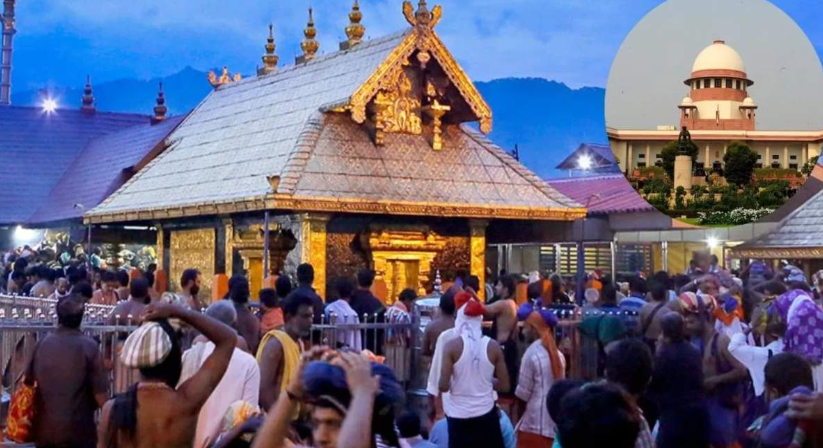
New Delhi: The decades-long controversy over the entry of women into the Sabarimala temple in Kerala has now reached a decisive turning point. Chief Justice of India Surya Kant has constituted a nine-judge Constitution Bench to hear the review petitions filed in this sensitive matter. This nine-judge bench will begin hearing cases directly related to the conflict of interest and traditional beliefs on April 7, 2026, and will be presided over by CJI Surya Kant himself.
The Supreme Court has prepared for a major hearing on the Sabarimala temple entry dispute. A nine-judge Constitution bench headed by Chief Justice Surya Kant will hear the review petitions beginning April 7, 2026.
Supreme Court Chief Justice Surya Kant has constituted a nine-judge bench to resolve the long-standing dispute over women’s entry into religious places and faith. This nine-judge Constitution bench will begin hearing from April 7 on issues such as the entry of women into mosques, abolition of the practice of ‘khatna’ (female genital mutilation) in the Dawoodi Bohra community, and allowing Parsi women into Agiaries (fire temples).
He has constituted a special Constitution Bench of nine judges, the special thing is that along with judges from different religions, a woman judge has also been included in this bench, so that no question arises on the fairness and comprehensiveness of the decision.
The Constitution Bench comprises Justice B.V. Nagarathna, Justice M.M. Sundaresh, Justice Ahsanuddin Amanullah, Justice Arvind Kumar, Justice Augustine George Masih, Justice Prasanna M. Varale, Justice R. Mahadevan and Justice Joymalya Bagchi.
This case relates to the Supreme Court’s 2018 decision regarding the entry of women into the Sabarimala temple. A five-judge Constitution Bench, in a majority verdict, declared the ban on women aged 10 to 50 entering the temple unconstitutional. The Supreme Court held that this practice discriminates against women and violates the fundamental spirit of Articles 14 (right to equality) and 25 (religious freedom) of the Constitution.
The entire controversy revolved around the belief that Lord Ayyappa is a “naistik celibate.” However, in its landmark decision, the Supreme Court allowed women of all ages to enter the Sabarimala temple.
Join our whatsapp group for Latest updates
Click Here for Chhattisgarh News
Click Here for Entertainment News