


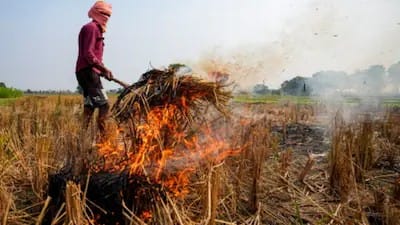
Fazilka: Punjab government’s attempt to curb stubble burning has taken a new twist in the border area of Fazilka where waterlogged fields have hampered farmers from using the machinery meant to be used for stubble burning, an issue for which the state government has urged them to adopt immediately.
In a few villages farmers report that groundwater level is near the surface and that seepage is constantly present and causes fields to be saturated, and therefore not suitable for farming.
Consequently, a tractor, baler or similar heavy farm machinery can get bogged down and thus hamper a farmer’s ability to harvest and care for the paddy straw without burning it.
CAQM Team Inspects Affected Villages
The problem became apparent after a visit to the villages of Fazilka by a team of the Commission for Air Quality Management (CAQM) while the air quality was a matter of concern in the country.
The team evaluated stubble management arrangements and looked into the difficulties experienced by the farmers in agricultural equipment operation.
A farmer of the village Dhipanwali, Thakar Singh Bhullar said very high groundwater level was an obstacle in moving machines in the farm most of the time.
Conditions may also make the making at the aggregates of paddy straw bales and transportation out of place of the straw bales difficult.
High Groundwater Affects Post-Harvest Operations
Waterlogging continues in a few areas of Punjab due to seepage up from the ground, which makes the soil completely waterlogged for longer durations.
Not only is it an issue with stubble management, it also poses problems in the sowing operations and other post harvest agriculture tasks.
In some places, shared by farmers, the ground water is just a few feet below the surface and is not a feasible option to address the stubble burning problem when farmers can use machinery.