


SC rules out blanket ban on firecrackers, says maintain balance between religious sentiments and health

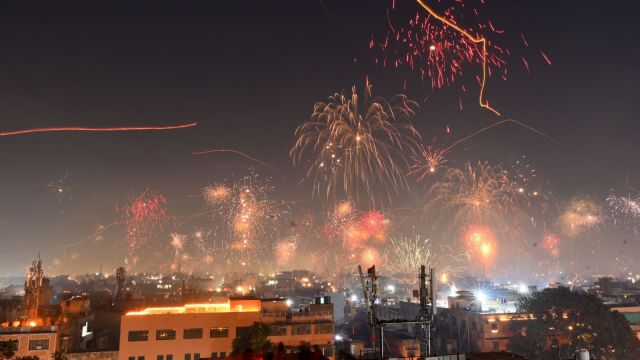
The Supreme Court in its order on Wednesday indicated that it would not impose a blanket ban on fireworks or permit their unrestricted use. However, prompted a balance between religious sentiments and health.
Hearing the long-pending Arjun Gopal vs Union of India case filed by three infants highlighting the health hazards caused by firecrackers and seeking restrictions, a bench of Justice M.M. Sundresh and Justice Augustine George Masih said, “We make it very clear. Neither we are going to agree with you for total ban. Nor we are going to allow them to do it 24 hours. For two reasons. Total ban will have some sentimental effect, number one. Number two, allowing them throughout the day will have a huge impact on every other living beings including old people, sick people and the children. We need to find a solution whereby we can give specified time and we can specify what are the crackers to be used.”
In its order, the court also permitted the manufacture, sale and use of the earlier banned joint firecrackers, also known as ladis or series crackers, in 2018, owing to the concerns over air pollution, noise pollution and solid.
During the hearing, Additional Solicitor General Aishwarya Bhati informed the court that the ministry had consulted stakeholders and obtained recommendations from the CSIR, National Environmental Engineering Research Institute regarding the specifications for joint firecrackers. The conditions prescribed by the board included restrictions on all shell size, the number of shells and the time interval between successive bursts. The court had on 22nd July asked the government to examine whether a partial relaxation of existing restrictions could be granted for certain type of firecrackers subjected to the prescribed noise standards of 125 decibels. Appearing for some of the manufacturers, advocate Pranav Sachdeva submitted that the new specifications were based on further research conducted pursuant to the court’s direction. He added that the prescribed restrictions would help reduce the particulate matter emission. However, advocate Pooja Dhar for the petitioners opposed the proposal, arguing that the court had previously prohibited such crackers and highlighted that the restriction on the timing of the firecracker use were not effectively enforced.
The Union Environment and other hand, saw traditional times, complete the outdoor testing to assess the environmental impact of barium in generating green crackers. Bhati, in its report, said that the CSIR and NEERI had. The Central Pollution Control Board had recommended conducting outdoor tests for cities Bhopal, Delhi, Kolkata and Chennai to assess the impact of barium-containing green firecrackers under different air quality conditions. Got time until October 15th to submit the results of the outdoor testing. Earlier on September 2nd, the court had granted CSIR nearly two weeks to undertake the proposed study of the impact of varying content on the generation to green fire crackers at the four locations. It had also directed the ASG to provide details of the safeguards recommended for joint firecrackers.
²