


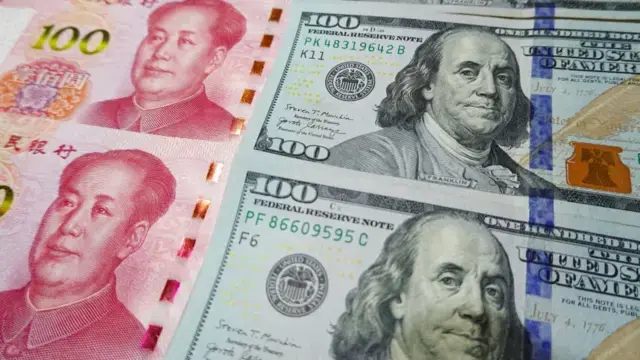
Piyush Goyal settled an argument in Jaipur this August that Beijing probably didn’t want settled. Speaking after a BRICS trade ministers’ meeting, the Commerce Minister said flatly that India does not support any move towards a common BRICS currency. A few weeks earlier, the Ministry of External Affairs had said something similar in Delhi: de-dollarisation, in so many words, is not on India’s agenda. That’s two firm no’s from New Delhi in one season, and they tell you something the yuan-versus-dollar debate usually skips over — the countries most invited to gang up against the dollar aren’t actually lining up behind China’s currency either.
So where does the yuan actually stand? Not where the headlines suggest, and not where Beijing’s own central bank governor suggests either.
The reserves don’t lie, even when the rhetoric does
Start with the IMF’s COFER data, the closest thing to a global scoreboard for currency trust. As of the second quarter of 2025, the dollar held 56.32% of allocated global reserves — down a touch from the previous quarter, though the IMF attributed most of that dip to currency appreciation rather than central banks actually dumping dollars. The euro was parked at just over 21%. The yuan sat at 2.12%, exactly where it had been the quarter before. Flat.
Payments tell a similar, slightly messier story. SWIFT had the yuan as the world’s fifth most-used payments currency in January 2026, with a 3.13% share. Sounds like progress until you notice the trend line: the yuan’s SWIFT share had actually peaked near 4.74% back in mid-2024 and slid to somewhere between 2.75% and 3.1% by early this year. China’s own central bank governor calls the yuan the third-largest payments currency in the world. SWIFT’s numbers don’t back that up, and the gap between the two claims is really the whole story of yuan internationalisation in one sentence.
China’s real weapon isn’t the yuan, it’s the plumbing
Where Beijing is genuinely making ground is less glamorous than reserve currency status. Its Cross-Border Interbank Payment System — CIPS — now runs through 210 direct and over 1,600 indirect participants spread across 189 countries, and cross-border yuan settlement through it touched $9.9 trillion in 2025, up more than 10% on the year. Daily volumes kept climbing through 2026 too. This is the one place yuan usage is setting records rather than stalling.
China has also started pricing things in yuan rather than just settling trades in it — a subtler but arguably bigger deal. Oil futures in Shanghai, lithium contracts in Guangzhou, rare-earth pricing, all increasingly denominated in renminbi. Experts at this year’s World Economic Forum session on the currency flagged this as the area with the most genuine runway left, more so than reserve holdings ever will be. Add the digital yuan into the mix — the mBridge cross-border CBDC project has now processed roughly $55 billion in transactions, 95% of it in digital yuan, with the UAE recently plugging into the system — and you can see why Beijing keeps insisting the trend is irreversible.
The wall Beijing keeps running headfirst into
Except it can’t have everything. Economists have a name for this: the monetary trilemma. A country can manage its exchange rate, keep monetary policy independent, or allow capital to flow freely — pick two. China picked the first two, decades ago, and hasn’t changed its mind since. Hong Kong exists partly to soften that choice, letting foreign banks trade offshore yuan, dim sum bonds and Stock Connect without Beijing ever having to open the mainland capital account for real.
Analysts at the Asia Society don’t mince words about what full internationalisation would actually cost China: giving up capital controls, allowing genuine convertibility, and building a legal system markets trust rather than one the Party controls. None of that fits anywhere on Beijing’s current list of priorities. Even China’s own regulators admit as much — the state agency overseeing foreign exchange has said capital account opening and yuan internationalisation will move together, but “prudently, gradually and in a controlled manner.” Translate that out of bureaucrat-speak and it means: don’t hold your breath for a date.
Where India actually fits into this fight
This is the part that gets lost when the story is framed purely as Washington versus Beijing. India has skin in this game too, and its instinct has been to stay well clear of anything that smells like a China-led alternative. RBI Governor Shaktikanta Das has said outright that India has taken no steps to de-dollarise, and that the real goal is simply to de-risk trade so it isn’t hostage to one currency’s swings. That’s a very different ambition from Russia’s or, at times, China’s own — India wants the rupee used more in cross-border settlement, not the yuan installed as some regional alternative to the dollar. Part of that reluctance is plain old India-China rivalry: New Delhi has openly worried that a BRICS currency would end up looking a lot like a yuan-dominated project, handing Beijing exactly the kind of leverage the dollar gives Washington.
India’s other move has been quieter and arguably says more than any statement from South Block. The RBI has been buying and repatriating gold at a pace that would have seemed excessive a decade ago — its holdings now stand at 880.52 tonnes, with gold’s share of India’s forex reserves climbing from under 12% in 2024-25 to nearly 17% by mid-2026. More than three-quarters of that gold now sits in vaults inside India rather than with the Bank of England, a shift RBI watchers link directly to the West freezing Russia’s dollar reserves after the Ukraine invasion. If there’s a global lesson embedded in India’s own reserve strategy, it’s the same one showing up in central bank vaults from Warsaw to Jakarta: when trust in the dollar wavers, the money doesn’t run to the yuan. It runs to gold.
So, can it actually happen?
Not soon, and probably not in the shape the “de-dollarisation” headlines imagine. The dollar’s edge was never really about the size of the American economy — it’s the accumulated weight of decades: the deepest, most liquid bond market on the planet, a legal system global investors are willing to bet on, and a mountain of existing contracts priced in dollars that nobody has any real incentive to unwind overnight. China’s own economists are candid about this too, describing the dollar’s recent slide as ordinary diversification rather than the start of any collapse.
The more realistic picture, for India as much as anyone, is a slow fraying at the margins rather than a changeover at the centre: a bit more oil billed in yuan, a bit more Belt and Road trade settled outside SWIFT, a lot more gold sitting in central bank vaults, rupee settlement inching up in India’s own trade corridors — and the dollar still sitting at the middle of the system a decade from now, just a shade smaller than it is today.