


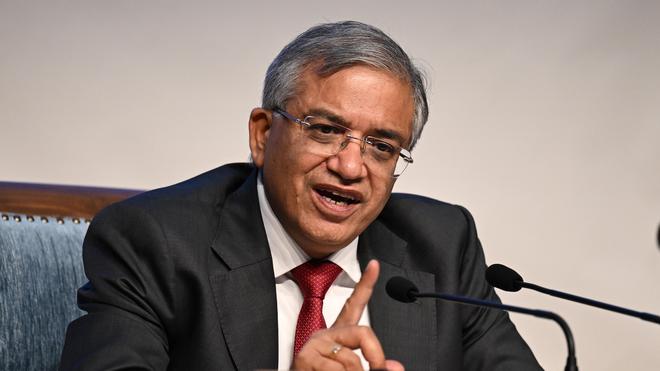
Every few months, someone in Parliament threatens to remove the Chief Election Commissioner. This time, the threat has actually got legs — because for the first time, the demand isn’t coming only from politicians unhappy with an election result. It’s coming from inside the Commission itself.
What actually happened
The story broke through a series of reports this week, which said Election Commissioners Sukhbir Singh Sandhu and Vivek Joshi had raised objections at least 14 times over the past 10 months regarding the Special Intensive Revision of electoral rolls and certain internal procedures, with four of those objections apparently logged on a single day. The ECI’s response was measured — it said written notes, observations and internal checks and balances are a standard part of how the Commission works, and that differing views during deliberations are normal, insisting every final decision, including on the SIR, was unanimous.
One flashpoint stands out: Form 6, the form new voters use to register. The reported change added a question asking applicants to establish their own or their parents’ or grandparents’ presence in earlier electoral rolls — the kind of documentation burden that critics say could quietly disenfranchise people who can’t easily prove ancestry on paper. Sandhu and Joshi are reported to have objected to it.
The politics moved fast after that. Congress workers protested in Delhi, Chandigarh, Patna, Kolkata and several other cities, and Congress has reached out to other opposition parties about a possible removal motion against Kumar in both Houses of Parliament. Separately, on September 25, a petition was filed in the Supreme Court seeking Kumar’s prosecution under the Representation of the People Act, alongside a demand for an independent probe into the alleged deletion of around 13 crore voter names across 30 states and Union territories. Worth flagging clearly: that petition contains the petitioner’s allegations, not a finding by any court.
None of this, on its own, removes a CEC. That takes something a lot more specific.
How a CEC can actually be removed
Article 324(5) of the Constitution gives the CEC unusually high protection — he can only be removed the same way, and on the same grounds, that apply to a Supreme Court judge. The 2023 law governing the Commission repeats this protection in its own clauses, and adds that while the CEC can resign anytime by writing to the President, nobody can push him out except through this route. Not the Prime Minister. Not the government. Not the Election Commission itself.
What that route actually means: the same two grounds that apply to a Supreme Court judge — proved misbehaviour, or incapacity — and the same procedure laid out under Article 124(4) and the Judges (Inquiry) Act, 1968. Here’s how it runs in practice:
100 Lok Sabha MPs (or 50 Rajya Sabha MPs) sign and submit a notice
→ the Speaker or the Rajya Sabha Chairman decides whether to even admit it
→ if admitted, a three-member committee — typically a Supreme Court judge, a High Court Chief Justice and a jurist — investigates the charges and reports back
→ if the charges are held proved, both Houses debate and vote on the motion, each needing a majority of its total membership plus two-thirds of members present and voting
→ that address goes to the President, who alone issues the formal removal order
Every single link in that chain matters, and the second one is where most attempts have already died. In March this year, a TMC-led notice with 130 Lok Sabha signatures and 63 in the Rajya Sabha — comfortably above the 100/50 threshold — was submitted invoking exactly this framework. A month later, both the Speaker and the Rajya Sabha Chairman rejected it without giving a reason, something Opposition MPs called out at the time. Getting enough signatures is only step one. Getting admitted is the actual hurdle, and it’s almost entirely a judgment call by the presiding officer.
CEC vs the other Election Commissioners
Worth remembering this isn’t uniform protection. The two Election Commissioners, Sandhu and Joshi, don’t enjoy the same shield as Kumar. The law says an EC can’t be removed by the President except on the CEC’s own recommendation — meaning, ironically, the two officers reportedly raising objections about the CEC’s decisions could, in theory, be removed at his suggestion, while he can’t be touched except through Parliament.
Why “impeachment” isn’t quite the right word
That borrowed process is also why “impeachment” keeps getting thrown around loosely in the coverage. Procedurally, CEC removal and judicial impeachment are close enough — same grounds, same Act, same majority thresholds — but the Constitution itself reserves the word impeachment for removing the President. What Kumar could face, if it ever got that far, is a removal motion that borrows the judge’s process wholesale, not an impeachment in the strict constitutional sense.
Two other things come up often, and both have flat answers. The President has no independent power here — his role kicks in only after Parliament has already passed the motion, and even then it’s a formality, signing off on a decision the two Houses made rather than making one himself. The Supreme Court is in a similar position. It can hear petitions, order forensic audits, direct investigations — exactly what the September 25 plea is asking it to do — but it cannot remove a sitting CEC on its own. That power sits with Parliament, and nowhere else.