


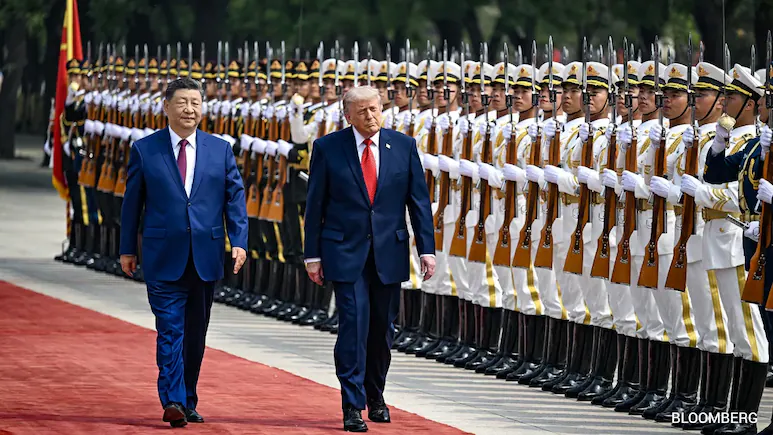
US President Donald Trump and Chinese President Xi Jinping are scheduled to meet in Washington on September 24, a day after making an important breakthrough in talks for a U.S.-China tariff truce. Trade and artificial intelligence, critical minerals and the future of a possible U.S.-China tariff agreement are expected to be discussed in the meeting between the leaders of the world’s two largest economies.
The summit is taking place after recent escalations in the trade war between Washington and Beijing have put relations between the two parties on the rocks. Negotiations between high-level officials of both countries started in New York on Sunday to address differences and lay the groundwork for the Trump-Xi talks.
Trade Truce And Tariffs Take Centre Stage
The latest round of economic talks is being led by US Treasury Secretary Scott Bessent and Chinese Vice Premier He Lifeng, as well as US Trade Representative Jamieson Greer. Talks are aimed at tariffs, agriculture and energy trade, scarce-earth materials and what’s next with the current agreement set to expire November 10.
Washington is mulling the possibility of lowering the tariff on nonsensitive China products, and Beijing may look for more security in trade relations. Both sides have come up with a proposal to sell rare earth metals from China to New Zealand and the import of various critical minerals needed for industry from New Zealand to China, including in electronics, automobiles, high-tech operations, and numerous other industries.
The Trump team has also refused to disclose plans for tariffs tied to the case of China’s overcapacity in certain industries, allowing the issue to remain part of the main talks.
AI And Technology Add New Pressure
Another key concern prior to the summit is that of artificial intelligence. While advanced machine learning is being developed, both governments are restricting exports of North American sensitive technologies and semiconductors in APRA.
Bessent has said that talks might encompass both open weight and closed weight AI models, in addition to containment measures to guard against potential dangers arising from the technology. At the New York meeting, the U.S. offered a way to communicate on an incident if AI inflicts challenges to the national security of either country.
The rare earths exports are likely to be tied to the technology talks as the materials play a vital role in producing many high-tech and industrial products. The Chinese government has in the past restricted some key minerals, which has alarmingly worried concerned manufacturers in the USA and elsewhere in the world.