


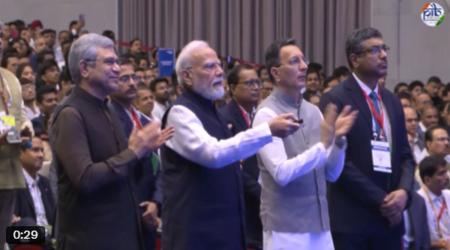
Prime Minister Narendra Modi on Thursday inaugurated the Semiconductor India 2026 exhibition and interacted with participants before opening the event at the Yasho Bhumi Convention Centre in Delhi. The event, a two-day programme, will focus on industry engagement, policy direction and international partnerships. According to the Ministry of Electronics and Information Technology, the conference is being organised jointly by the India Semiconductor Mission, Ministry of Electronics and Information Technology, and global industry body SEMI under the theme “Silicon to Systems, Building the Ecosystem”.
SEMICON India 2026 will adopt a comprehensive value-chain approach, showcasing the journey from semiconductor materials and manufacturing to advanced packaging, design, electronics and systems,” the Ministry stated.
“The new ‘Sand to Silicon to Systems’ Value Chain Experience will provide visitors with an integrated view of the semiconductor ecosystem and demonstrate India’s expanding capabilities across different stages of the value chain,” the Ministry added.
According to officials, the convention is expected to attract over 600 exhibitors, including 300 international firms, across 1,500 square metres, alongside more than 150 speakers. The exhibition will feature six country pavilions and twelve state government pavilions, alongside dedicated segments for startups, student hackathons and workforce development. An official review of the manufacturing milestones will also be present at the event. The Union government, under the Semicon India programme, approved 12 semiconductor projects, with three approved units under Semicon 1.0 having commenced commercial production. The Union Cabinet additionally approved the next phase, Semicon 2.0, structured around six core pillars.
The event will provide an opportunity for Indian and national companies to explore partnership investment, technology collaboration, and supply chain linkages, further strengthening India’s position as a trusted global semiconductor partner. Among the key global and domestic enterprises participating are ASML, Applied Materials, Teradyne, Infineon, Ibara, Jabil, IBM Research, NXP, Tata Electronics, Micron, Merck KGaA, Rapidus, Lam Research, and CG Power, among several others.