


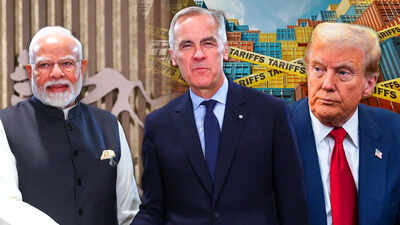
The escalating US-Canada trade war could create an unexpected opening for Indian exporters. As US goods now turn expensive India could tap the opportunity and fill up the gap.
As Washington and Ottawa raise tariffs on each other’s goods, businesses on both sides may increasingly look for alternative suppliers — and India, with its growing manufacturing capacity and established export base, could be among the countries that benefit.
Whats Happening?
The US imposed 50 percent tariffs on around $20 billion worth of Canadian goods. Canada responded with retaliatory tariffs of up to 50 percent on roughly 700 US products, including steel, aluminium, electronics and other consumer and industrial goods.
With negotiations stalled, companies that earned their bread and butter from the integrated US-Canada supply chain could now have to look elsewhere.
India’s Position With the US
The US is India’s largest export market, making this dispute particularly important for Indian businesses. US-India goods trade reached an estimated $149.1 billion in 2025, with US imports from India at $103.8 billion.
India already has a strong presence in the American market across pharmaceuticals, engineering goods, electronics, textiles, machinery and other manufactured products — giving Indian exporters an advantage if US companies begin searching for alternatives to Canadian suppliers, since they already have established production capabilities and experience in the market.
India’s Relationship With Canada
Trade between India and Canada doesn’t come close to the India-US numbers, but it’s worth watching. In 2025, the two countries did $10.9 billion in two-way merchandise trade, and Canada bought about $7 billion worth of goods from India.
There’s also a bigger deal in the works — a Comprehensive Economic Partnership Agreement, or CEPA — and governments had earlier floated $50 billion as the bilateral trade goal for 2030.
Ottawa has spent the last while trying to lean less on the US for trade, and that push toward diversification is exactly why India shows up as a plausible option for Canada to lean into instead.
Why India could benefit?
At its core, this is a story about supply chains scrambling to reroute themselves. Once Canadian goods get more expensive for American buyers, someone else has to fill that gap — and Indian steel, pharma, electronics, textiles and machinery are all reasonably placed to pick up some of that business.
It’s not just speculation, either. NITI Aayog has run the numbers on this and found India could become more competitive in 22 of the top 30 US product categories, which together make up about 61 percent of what India already exports to America.
That said, none of this happens automatically. Getting the orders still means beating out other suppliers on price, quality and consistency — the trade war opens a door, but Indian companies still have to walk through it.