


Are the dark stores really dark? Lets look at how the 10 minute delivery apps have become a part of our lives

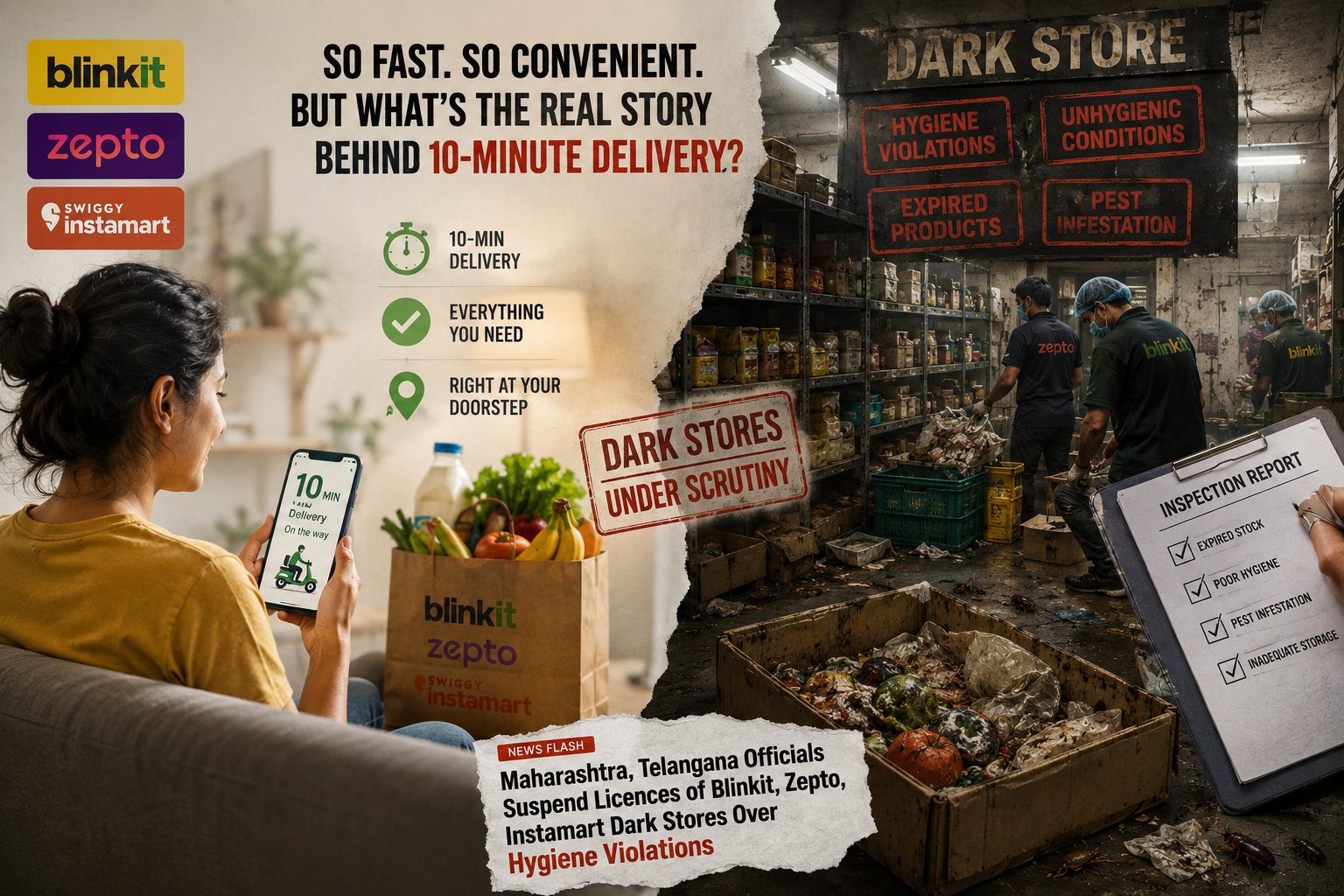
Somewhere between ordering a forgotten ingredient and it landing at your doorstep, ten minutes have quietly become the new normal. Put a number on it and the scale gets hard to ignore: India’s quick commerce business is now pegged at around ₹1.08 lakh crore, expanding close to 40% a year — over twice the speed of digital retail as a whole.
Blinkit, Zepto and Swiggy Instamart alone are running upwards of 5,000 dark stores between them, a jump from about 3,400 just twelve months back. For a lot of people living in cities, these tucked-away micro-warehouses have quietly taken over the job the neighbourhood kirana shop used to do — groceries, medicines, snacks, whatever’s needed, all coming from the same invisible source.
What nobody really talks about is what that source actually looks like once you get past the app.
Over the past few weeks, that backend has been thrown into uncomfortable light. In mid-August, Maharashtra’s Food and Drug Administration inspected 86 dark stores across the state and suspended 14 licences — including facilities run by Blinkit, Zepto and Instamart — for hygiene violations.
At a Blinkit outlet in Malad West, Mumbai, inspectors didn’t just find expired stock — they found cockroaches crawling over produce that was still meant to go out for delivery.
Around the same stretch of time, Telangana’s food safety teams showed up unannounced at some 20 dark stores run by BigBasket, Blinkit and Zepto in Hyderabad, and what they walked into wasn’t much better: dust-covered shelves, ventilation that barely worked, and cold storage that wasn’t holding temperature the way it should.
And this isn’t the first time either — earlier inspections had already turned up fungal growth on packaged products at a Zepto site in Mumbai, while a Blinkit warehouse in Telangana was flagged by officials in fairly blunt terms: disorganised, unhygienic, dusty.
The question this raises isn’t just about spoiled milk or stale snacks.
It’s about whether a sector that has embedded itself into daily life at breakneck speed has been allowed to grow largely unchecked behind the scenes — and whether consumers, busy enjoying the convenience, were ever told what was happening in the ten minutes before delivery.