


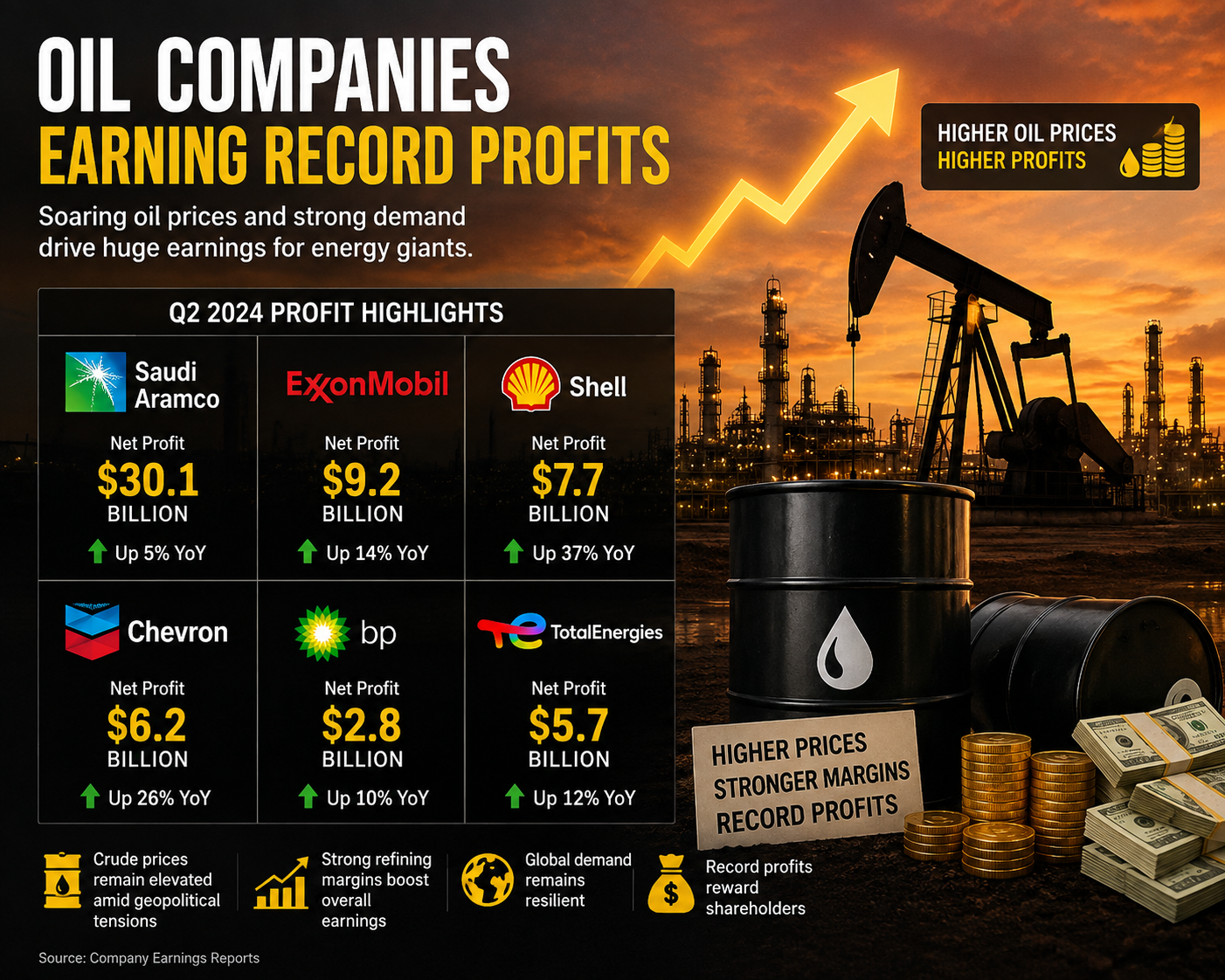
A war that’s made fuel pricier for everyone else has somehow been fantastic business for the companies that pump it. That’s not spin — it’s just what the numbers say this quarter.
Brent slips below $80 for the first time in weeks
Hopes for a deal to normalise shipping through the Strait of Hormuz pushed Brent crude below $80 a barrel for the first time in more than three weeks, easing to $79.62. WTI ticked up slightly to $75.90, holding fairly steady while investors waited for something concrete on the diplomatic front — specifically, whether talks to end the US-Iran standoff and reopen the blockaded strait were actually going anywhere.
A look at the actual profit numbers
Exxon Mobil brought in $14.5bn in second-quarter earnings — $14.7bn on an adjusted basis — its best quarter in four years. Chevron wasn’t far off at $12bn, a six-year high that beat what analysts had been expecting. Shell, Europe’s largest oil company, more than doubled its second-quarter earnings to almost $10bn. Total Energies had its strongest quarter in nearly three years, up 67 percent. BP came in at $5.73bn, more than double the $2.35bn it made a year earlier. And Saudi Aramco, still the world’s biggest producer by a wide margin, saw earnings climb 44 percent year-on-year to $32.69bn.
Why the money keeps flowing
There’s no trick to this. Extraction costs haven’t moved much — pumping oil out of the ground costs about what it always has. What’s different is what these companies get paid for it. Prices go up, margins go up with them, and none of the extra revenue requires extra spending to produce. Refiners are seeing the same effect on their end. Even older contracts, signed long before this crisis began, are now settling at today’s higher rates. Add in investors treating energy stocks as a hedge against more war, and valuations climb higher still.
Why Hormuz still the key factor
Roughly a fifth of the world’s oil moves through the Strait of Hormuz every day, so almost anything happening there — an attack, a threat, a rumour — moves prices within hours. That’s exactly why this week’s dip is being treated as cautious relief, not resolution.
The Outlook
It’s not the oil companies. Households are the ones absorbing costlier petrol, pricier flights, higher freight charges, and eventually, more expensive groceries, since moving and growing food both cost more too. Countries that import most of their crude — India among them — are particularly exposed the longer this drags on.
What Happens Next
These profit numbers have already reignited talk of a windfall tax, with critics arguing it’s unfair for oil firms to cash in this heavily during a crisis. The industry’s response hasn’t changed: these earnings fund the investment that keeps future supply secure. Everything from here hinges on whether the diplomacy around Hormuz actually holds.