


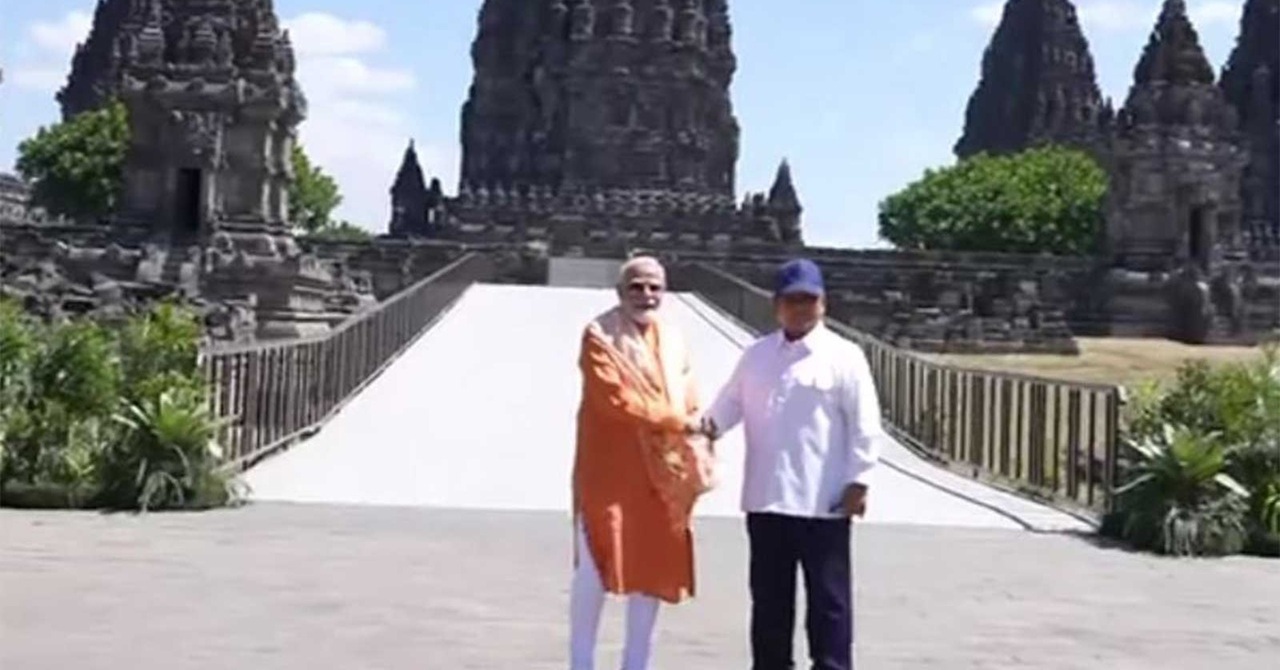
Prime Minister Narendra Modi on Wednesday visited Indonesia’s ancient Prambanan Temple complex alongside President Prabowo Subianto. The important develop comes a day after both countries announced a joint restoration project for the UNESCO World Heritage Site. Both the leaders offered prayers at one of Southeast Asia’s most significant Hindu monuments.
Sharing an aerial glimpse of the sprawling temple complex on X, PM Modi described it as “The majestic Prambanan Temple!”. However, the visit followed a major cultural initiative announced during bilateral talks a day earlier, when India and Indonesia agreed to jointly undertake the conservation and restoration of the Prambanan Temple complex.
The two countries exchanged a Letter of Intent for the preservation project while reaffirming their commitment to further strengthening the India-Indonesia Comprehensive Strategic Partnership under India’s Act East policy.
The initiative is aimed at preserving the historic monument while deepening civilisational and cultural cooperation between the two nations.
Situated on Indonesia’s Java island, Prambanan is the country’s largest Hindu temple complex and the second-largest in Southeast Asia after Cambodia’s Angkor Wat.
Spread over nearly 40 hectares, the complex originally comprised around 240 temples. Built during the 9th century under the Hindu Mataram Kingdom, it is believed to have been commissioned by King Rakai Pikatan and completed during the reign of his successor, Lokapala.
At the heart of the complex stand three towering temples dedicated to Lord Shiva, Lord Vishnu and Lord Brahma. The Shiva Temple, rising approximately 47 metres, is the tallest structure within the complex.
The temple walls feature elaborate carvings depicting episodes from the Ramayana and other Hindu epics, reflecting the deep cultural exchanges that flourished between the Indian subcontinent and Southeast Asia through ancient maritime trade routes.
Prambanan was abandoned in the 10th century, with historians attributing its decline to political changes in Java and volcanic activity from nearby Mount Merapi. The monument also suffered damage from earthquakes over the centuries before restoration efforts began during the Dutch colonial period.
Extensive archaeological restoration carried out between 1913 and 1953 helped revive the main temple structures. In 1991, UNESCO recognised Prambanan as a World Heritage Site.
The newly announced India-backed conservation project is expected to further strengthen the longstanding cultural relationship between New Delhi and Jakarta while helping preserve one of Asia’s most significant Hindu heritage sites.”