


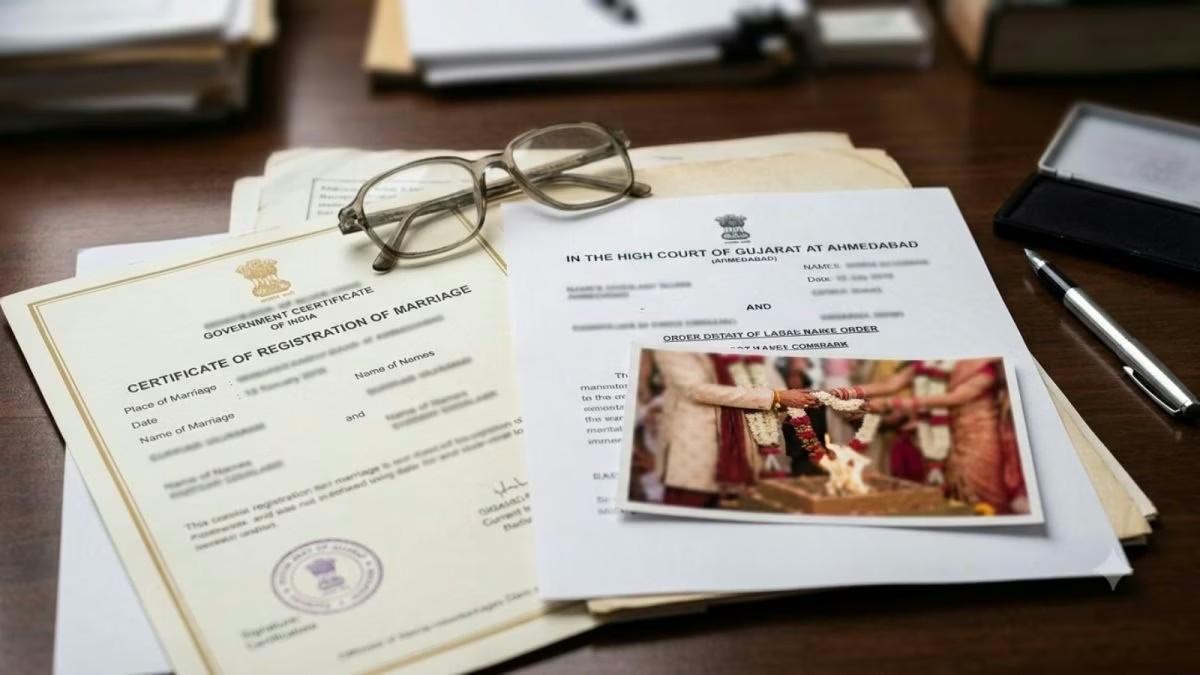
The Gujarat High Court has held that no Hindu marriage is legally valid without performing the customary ceremonies provided in the Hindu Marriage Act and formalities conducted in the registering certificate.
The order came while and after an appeal was filed by a man in the UK who had said he only came to know that he was allegedly “married” when a woman presented herself at his parents’ home in Ahmedabad, claiming to be his wife with a marriage certificate.
One division bench of Justice I.J. Vora, and Justice R.T. Vachhani, observed that “there were no ceremonies or any Hindu marriage rites celebrated.
The court noted that the institution of Hindu marriage is not just a civil or business engagement but a sacrosanct relationship and urged both parties strength.
The bench noted marriage is not just a day for song and dance, wining and dining, but is also not a commercial transaction.
It added that the moral, social and legal nature of marriage also does not arise in their absence of essential ceremonies as mandated under the Hindu law. So, if married without those ceremonies, there is really no marriage and legal status “husband and wife” cannot be deemed to exist.
The appellant had sought to set aside the marriage contending on the basis that his signatures in relation to the marriage documents had been acquired through misleading because he was an employee of the woman’s father’s. He also disagreed they were married at any point in the past.
The family court had previously denied the petition, saying a registered marriage certificate meant they had to start a proper trial as it subjected them to the presumption of a valid marriage. The High Court however overturned this decision, ruling that only an admission of the absence of essential marriage ceremonies is enough to render the marriage null and void without a trial even be required.
In this judgment, it reiterates the position that a Hindu marriage must be registered, but that registering a marriage is only proof of the marriage and it does not meet the necessary requirements of the essential religious ceremony required for a valid Hindu marriage.