


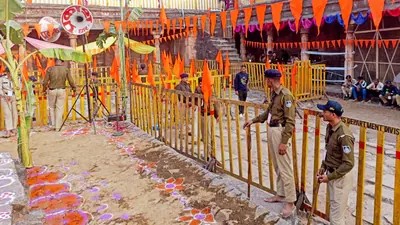
The Madhya Pradesh High Court has directed that the Bhojshala complex, which had been established as a site for both the Hindus and the Buddhists to pray to the Goddess Saraswati on specific days, be cancelled and that it is a temple.
The division bench of Justices Vijay Kumar Shukla and Alok Awasthi said it was a Hindu temple and that members of the Muslim community can ask for alternative land to use for worship activities related to the construction of the mosque. The decision effectively puts an end to the 2003 agreement between the Archaeological Survey of India (ASI) and the Hindu community, which allowed them to pray on Tuesdays, and that of the Muslim community, who could pray on Fridays.
The court has made this decision after taking into account archaeological reports and historical records and ASI findings. The Hindu petitioners had wanted special rights to worship at the Bhojshala complex as it had been built as a Saraswati temple and was also an ancient site for Sanskrit study.
The court in its detailed observations said it had arrived at its conclusions after taking into account the historical literature and archaeological evidence, as well as the principles of the constitution, such as Articles 25 and 26. It also pointed out that the Supreme Court’s verdict in Ayodhya was a precedent for addressing issues involving controversial religious sites.
The bench pointed out that the continuity in worship at the place had not been broken at all and drew on references indicating that there was a temple and a major centre of education there during the ancient times.
The court also noted the constitutional duty of the state with respect to the protection, preservation of order and preservation of the religious character of the site. The finding may impact the law and politics.